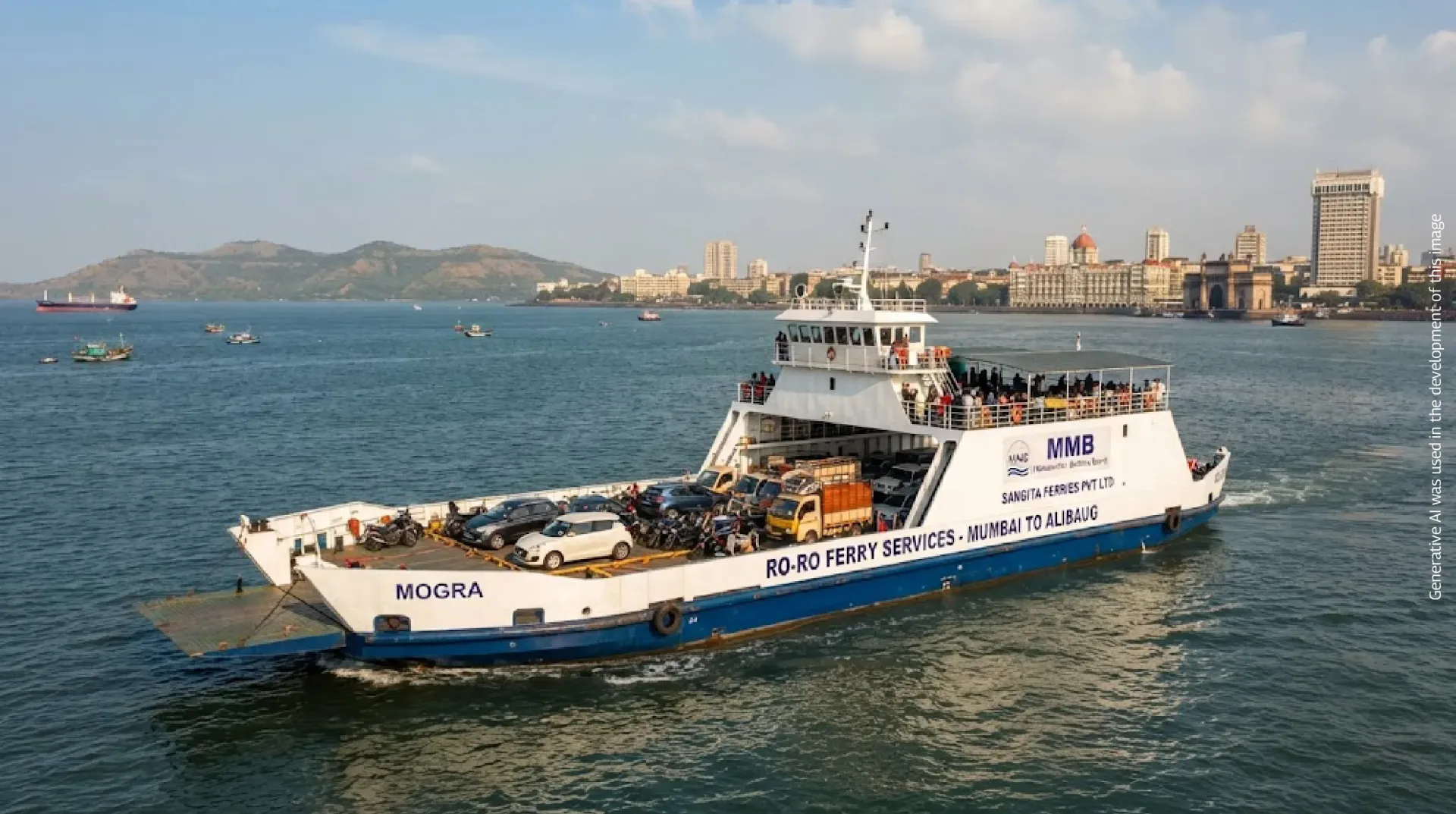
Not too long ago, planning a trip to Alibaug usually meant checking traffic conditions before anything else. Travellers routinely factored in highway congestion, weekend rush hours, and seasonal delays before deciding when to leave Mumbai.
Today, the conversation is rapidly evolving.
Improved coastal transportation options have unlocked new ways to reach Alibaug, making the journey far more convenient and enjoyable. Among these alternatives, the Ro-Ro Ferry Mumbai to Alibaug continues to attract surging interest from tourists, second-home owners, weekend travellers, and frequent visitors.
The appeal extends far beyond mere transportation. Seamless access has cemented Alibaug's position as one of Maharashtra's premier coastal destinations—transforming how people view short holidays, property investments, and second-home ownership.
The term Ro-Ro stands for Roll-On Roll-Off. Unlike conventional passenger ferries, Ro-Ro vessels are engineered to transport both passengers and vehicles simultaneously. Travellers simply drive their cars onto the vessel prior to departure and drive straight off upon arrival.
This capability has made the Ro-Ro Ferry Mumbai to Alibaug exceptionally appealing for families and property owners who prefer having personal vehicle access at their destination. By removing the friction of car rentals or transit transfers, it simplifies the travel experience entirely. You can check schedules and book vehicle slots directly through platforms like M2M Ferries.
Travel infrastructure directly dictates how frequently a region is visited and how investors perceive its potential. Improved access triggers a positive ripple effect:
Choosing how to travel across the harbor often comes down to predictability and comfort:
Alongside the Ro-Ro service, the water taxi Mumbai to Alibaug option has also captured significant attention. While primarily focused on rapid passenger transport, water taxis provide an efficient secondary alternative for swift commuting.
Together, ferries and water-based transit are forging a robust maritime ecosystem between Mumbai and Alibaug, boosting convenience for visitors and stimulating the local economy.
For years, Alibaug was pigeonholed strictly as a weekend tourist retreat. Today, it is increasingly evaluated as:
Smoother connectivity has acted as the primary catalyst for this shift, turning occasional getaways into practical, routine travel.
Alibaug has long held a cherished place among Mumbai residents. Nestled along the scenic Konkan coastline, the town offers a refreshing antidote to city life: pristine beaches, lush greenery, open spaces, and a slower, more deliberate pace of living.
Its broad appeal spans multiple demographics:
As accessibility improves through options like the Ro-Ro ferry, visiting regularly becomes effortless, encouraging deeper community and regional engagement.
Navigating the Mumbai-to-Alibaug maritime route is straightforward when you know the operational nuances. Whether you are planning a weekend escape or evaluating a second-home purchase, keeping these logistics in mind ensures a frictionless journey.
While traditional passenger catamarans (like PNP, Maldar, or Ajanta operating from the Gateway of India) allow easy on-the-spot walk-in counter purchases, Ro-Ro ferries (such as M2M Ferries from Bhaucha Dhakka) require advance planning. Because vehicle decks have limited capacity, car and SUV slots—especially for weekend getaways—sell out days ahead. It is strongly recommended to secure your passenger and vehicle passes online via official platforms like the M2M Ferries Portal.
Ferry pricing typically varies based on seating classes and the type of transport:
Monsoon season transforms the Konkan coast, bringing temporary shifts in transit operations:
The operational schedule for the M2M Ro-Ro Ferry (running between Bhaucha Dhakka/Ferry Wharf in Mumbai and Mandwa Jetty) typically features 3 to 4 daily trips in each direction, though exact departure slots adjust dynamically based on the tide, weather conditions, and seasonal demand.
While exact slot timings shift day-to-day, a standard operational day follows a structure similar to this:
Important Operational Notes:
Discerning property buyers look far beyond the four walls of a house, carefully evaluating the broader surrounding ecosystem:
Continuous capital investment in regional infrastructure signals strong institutional confidence. This confidence invariably sparks secondary growth across residential developments, commercial expansion, and community amenities. The growing popularity of the Ro-Ro Ferry Mumbai to Alibaug is a textbook example of how modern transport engineering can redefine a region's economic horizon.
Alibaug is not a single homogenous stretch; it is a diverse collection of distinct micro-markets, each offering a completely unique coastal rhythm, lifestyle appeal, and investment profile. Understanding these pockets helps second-home buyers map out exactly where their preferences align:
While each pocket has its merits, Nagaon emerges as the premier micro-market for discerning homeowners and investors, perfectly captured by master-planned developments like Mahindra Meridian.
The Ro-Ro Ferry Mumbai to Alibaug represents much more than a convenient travel shortcut; it underscores the vital role coastal infrastructure plays in regional development. For travellers, it delivers unmatched ease; for businesses, it fuels activity; and for homebuyers, it unlocks seamless access to one of Maharashtra's most desirable addresses.
Supported by ongoing regional development and premium residential opportunities from Mahindra Lifespaces, Alibaug stands firmly as a destination where accessibility, lifestyle, and long-term growth converge seamlessly.
Disclaimer: This article is for informational purposes only and should not be considered financial, legal, investment, or professional advice. Ferry schedules, fares, routes, and operational details may change. Please verify the latest information with official sources before making any travel or investment decisions.
The Ro-Ro ferry ride typically takes around 1 hour to 1.5 hours, depending on sea conditions and the specific terminal points (such as Bhaucha Dhakka/Mumbai to Mandwa). This makes it significantly faster and more predictable than navigating traditional highway routes during peak weekend hours.
Yes. The primary advantage of a Roll-On Roll-Off (Ro-Ro) vessel is its dedicated vehicle deck. You can easily drive your car, SUV, or two-wheeler onto the ferry in Mumbai and drive straight off upon arrival at Mandwa, giving you complete freedom of movement during your stay in Alibaug.
While both offer maritime transit across the Mumbai harbor, they serve slightly different purposes. The Ro-Ro ferry is designed to carry both passengers and vehicles, making it ideal for families and second-home owners. A water taxi is typically built for rapid passenger-only transport, offering efficient transit for quick trips or commuters who do not need to bring a car along.
Yes. While Alibaug was traditionally viewed strictly as a weekend tourist hotspot, improved maritime and road connectivity have transformed it into a practical location for remote professionals, retirees, and second-home buyers. Modern master-planned communities—such as Mahindra Meridian—provide the infrastructure, security, and lifestyle amenities needed for comfortable, long-term living.
When evaluating coastal real estate, smart homebuyers look beyond the property itself to assess the surrounding ecosystem. Key considerations include:

Established in 1994, Mahindra Lifespace Developers Ltd. (‘Mahindra Lifespaces’) brings the Mahindra Group’s philosophy of ‘Rise’ to India’s real estate and infrastructure industry through thriving residential communities and enabling business ecosystems.


