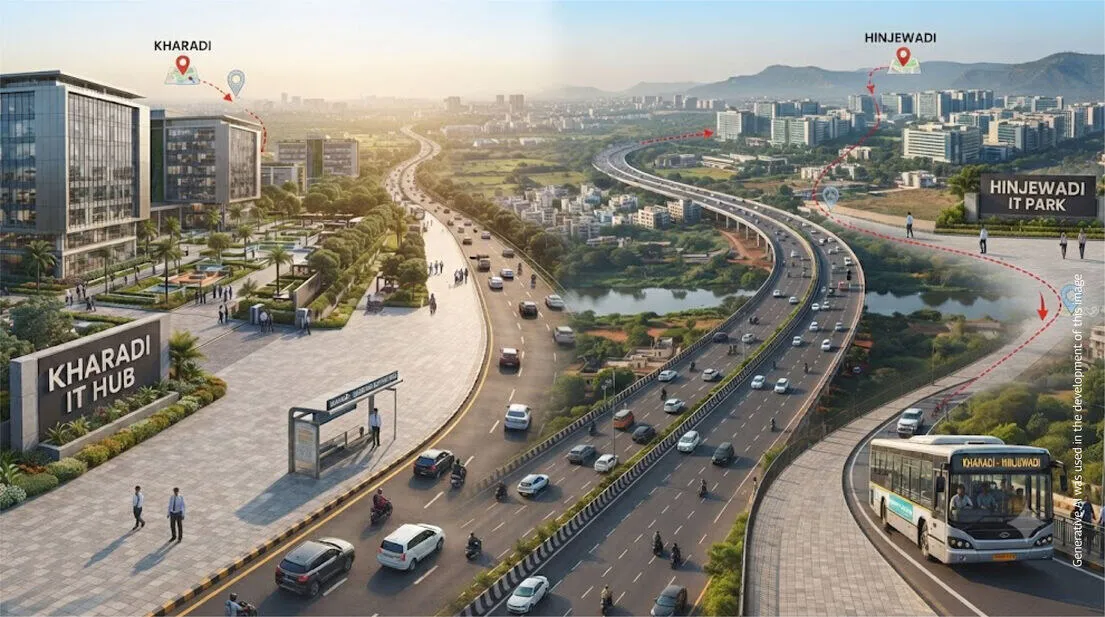
The Kharadi to Hinjewadi distance is approximately 25 to 30 km, depending on the route and destination phase within Hinjewadi. Travel time typically ranges from 45 minutes during non peak hours to 90+ minutes during rush hours. The most commonly used routes pass through Baner, Wakad, University Circle, and Mundhwa, connecting two of Pune's largest IT hubs.
Pune's employment landscape is unique.
Instead of having a single central business district, the city is driven by multiple technology and commercial hubs. Among them, EON Free Zone Kharadi and Hinjewadi's Rajiv Gandhi Infotech Park stand out as two of the most important employment centres.
As professionals change jobs, many find themselves living in Kharadi while working in Hinjewadi, or vice versa. This has made the Kharadi to Hinjewadi distance one of the most searched commuting queries in Pune.
EON Free Zone Kharadi has played a significant role in transforming eastern Pune into a thriving commercial destination. Today, the area is home to numerous global IT companies, banking and financial services firms, business parks, corporate offices, and modern co-working spaces, creating a vibrant business ecosystem. The presence of EON Free Zone Kharadi, World Trade Center Pune, and several nearby commercial developments has further strengthened Kharadi's position as one of Pune's most sought after locations for both employment and residential living.
Located in western Pune, Hinjewadi is home to:
Together, Kharadi and Hinjewadi form the backbone of Pune's technology economy and are among the city's most important IT corridors.
Travel Parameter | Details |
Average Distance | 25 to 30 km (depending on the route via the Bypass or inner city links) |
Non-Peak Travel Time | 45 to 55 minutes |
Morning Peak Hours | 70 to 90 minutes |
Evening Peak Hours | 75 to 100 minutes |
Weekend Travel Time | 40 to 50 minutes |
While the physical distance may appear manageable on paper, Pune's cross-city traffic conditions have a far greater impact on your daily routine than the actual kilometers traveled.
One of the most common miscalculations is assuming distance equals travel time. In reality, traversing this 30 km corridor can vary drastically based on your precise departure window:
Departure Time | Estimated Travel Time | Traffic Intensity & Bottlenecks |
Before 7:30 AM | 40 to 50 minutes | Smooth movement across the bypass and arterial flyovers before heavy commercial traffic builds up. |
8:00 AM to 9:00 AM | 70 to 90 minutes | Heavy congestion accumulating around Baner, Wakad, and University Circle intersections. |
9:00 AM to 10:00 AM | 80 to 100 minutes | Peak morning rush hour; significant bottlenecks entering Hinjewadi Phase 1 and Phase 2. |
1:00 PM to 4:00 PM | 45 to 60 minutes | Moderate, predictable traffic flow with minimal cross-city delays. |
6:00 PM to 8:00 PM | 75 to 95 minutes | Heavy evening outflow from IT parks colliding with residential return traffic. |
Pro Tip: Many seasoned professionals working in Hinjewadi deliberately depart from Kharadi before 7:45 AM to successfully bypass the heavy gridlock around Baner and Wakad. This practical departure-window strategy is essential for anyone considering a cross-city commute.
Best for
Advantages
Challenges
Best for
Advantages
Challenges
Best for
Advantages
Challenges
Bridging Pune's eastern and western IT corridors requires navigating significant urban distances. Commuters travelling between Kharadi and Hinjewadi rely on a mix of public transit, private networks, and shared mobility solutions.
Multiple Pune Mahanagar Parivahan Mahamandal Limited (PMPML) bus routes connect Kharadi and Hinjewadi, typically requiring transfers at major transit hubs such as Pune Station, Swargate, or Wakad. While it serves as the most economical mass transit choice, travel times can vary heavily during peak morning and evening rush hours.
Many large technology enterprises and multinational corporations operating across EON Free Zone in Kharadi and the various phases of Hinjewadi IT Park provide dedicated, air-conditioned employee transport fleets. These corporate buses significantly ease daily transit for eligible professionals by offering point-to-point pickup and drop services.
Carpooling has emerged as a vital commuting strategy for professionals traversing the cross-city corridor between Kharadi and Hinjewadi. By sharing rides with colleagues or verified peers, commuters successfully lower fuel expenses, split toll and maintenance costs, reduce the cognitive fatigue of driving through heavy traffic, and lower their overall carbon footprint. It remains a highly practical, cost-effective alternative for regular tech park commuters.
Mode of Transport | Approximate One-Way Cost |
PMPML Bus | ₹30 to ₹80 |
Shared Cab / Auto Pooling | ₹100 to ₹250 |
Two-Wheeler (Fuel & Maintenance) | ₹70 to ₹120 |
Private Car (Fuel & Tolls) | ₹180 to ₹350 |
Ride-Hailing Cab (Solo) | ₹500 to ₹900 |
For professionals commuting five days a week, cumulative transportation expenditures and travel fatigue heavily influence long-term residential decisions, driving many tech workers to seek housing closer to their respective workplaces or along upcoming transit corridors.
While many real estate analyses focus solely on current traffic conditions, long-term residential value and travel reliability are heavily anchored by upcoming civic investments. Several high-impact infrastructure projects currently underway across Pune are designed to streamline cross-city transit:
The ongoing development and extension of the Pune Metro network are set to significantly enhance connectivity between key residential catchments and major commercial employment hubs. By providing a high-speed, congestion-free alternative to road travel, upcoming metro lines will drastically improve transit reliability for daily professionals.
The multi-phase Pune Ring Road project spearheaded by the Maharashtra Road Development Corporation (MSRDC) aims to divert heavy, out-of-station freight and cross-city traffic away from inner-city arteries. By creating a high-speed orbital corridor around the metropolitan area, the project will drastically ease movement between eastern and western nodes like Kharadi and Hinjewadi without requiring transit through congested city center routes.
Targeted municipal upgrades are actively being deployed to eliminate severe bottlenecks at critical transit junctions. Key areas undergoing flyover construction, grade separators, and road-widening initiatives include:
For daily commuters and property investors, these staged infrastructure milestones will progressively cut down peak-hour travel times and enhance the livability of surrounding micro-markets.
The obvious answer for tech workers often seems to be "live closer to work." However, a significant number of professionals still choose to purchase or rent homes in Kharadi even while working across western IT parks like Hinjewadi.
Several key factors explain this preference:
Kharadi offers considerably faster and easier access to the Pune International Airport compared to Hinjewadi, making it an ideal residential base for frequent flyers, consultants, and corporate professionals who travel regularly.
Residents enjoy seamless access to a mature civic ecosystem, featuring:
Because Kharadi houses massive employment engines like the EON Free Zone and the World Trade Center (WTC), properties here enjoy continual rental traction from professionals working locally and across East Pune, ensuring strong asset liquidity.
Kharadi serves as a strategic gateway to eastern Pune, offering seamless arterial road access to:
This creates robust long-term lifestyle and resale advantages that extend well beyond the daily office commute.
Kharadi has evolved far beyond being just an IT destination and is now recognised as one of Pune's most complete urban ecosystems. The locality offers strong employment opportunities, excellent social infrastructure, premium residential developments, consistent real estate demand, and significant long term growth potential. These advantages continue to attract IT professionals, young families, NRI investors, and end users seeking a well connected neighbourhood with a high quality living environment.
For professionals looking to live in one of Pune's most promising residential destinations, Mahindra IvyLush offers an opportunity to experience thoughtfully designed living in Kharadi Annex.
What makes Mahindra IvyLush stand out is its focus on both comfort and sustainability.
Mahindra IvyLush has been thoughtfully designed to support modern, sustainable living through a range of future focused features. Key highlights include climate responsive homes, energy efficient design principles, enhanced natural light and ventilation, water conservation initiatives, and modern architecture that blends seamlessly with nature.
For professionals working in EON Free Zone Kharadi, Hinjewadi, Viman Nagar, Magarpatta, and other major Pune IT corridors, the project offers a strategic location complemented by evolving infrastructure and a well developed neighbourhood ecosystem.
The Kharadi to Hinjewadi distance may only be around 25 to 30 kilometres, but daily commuting involves much more than distance alone. Travel time, route efficiency, transportation costs, infrastructure upgrades, lifestyle preferences, and long term residential goals all influence the experience.
As Pune continues to strengthen its position as one of India's leading technology hubs, EON Free Zone Kharadi, Hinjewadi and other major Pune IT corridors will continue driving both employment growth and residential demand. This evolving landscape is one of the reasons why projects by Mahindra Lifespaces in Kharadi continue to attract attention from homebuyers looking for long term value and quality living.
For professionals seeking a location that combines connectivity, social infrastructure, lifestyle convenience, and future appreciation potential, Kharadi remains one of the city's most compelling destinations.
Disclaimer: This article is for informational purposes only and should not be considered travel, legal, investment, or professional advice. Information related to travel routes, commute times, transport options, infrastructure projects, Metro expansion, road conditions, and travel costs may change over time. Readers are advised to verify the latest traffic updates, transport schedules, and official infrastructure announcements before planning their journey or making any travel or property related decisions.
1. What is the exact Kharadi to Hinjewadi distance?
The distance between Kharadi and Hinjewadi is approximately 25 to 30 km depending on the route and destination phase.
2. How long does it take to travel from Kharadi to Hinjewadi?
Travel time ranges from 45 minutes during non peak hours to over 90 minutes during peak traffic.
3. Which is the fastest route from Kharadi to Hinjewadi?
The route via Mundhwa, Koregaon Park, Baner and Wakad is generally preferred by daily commuters.
4. Is public transport available between Kharadi and Hinjewadi?
Yes. PMPML buses, company shuttles and shared mobility services connect the two locations.
5. Is Kharadi a good place to live for people working in Hinjewadi?
Yes. Kharadi offers strong social infrastructure, airport connectivity and residential options, making it popular among professionals.
6. Why is EON Free Zone Kharadi important?
EON Free Zone Kharadi is one of Pune's largest commercial and IT hubs, housing multiple multinational companies.
7. Which is better for families, Kharadi or Hinjewadi?
Kharadi is often preferred by families due to its established schools, hospitals, retail destinations and overall social infrastructure.
8. What are the upcoming infrastructure projects connecting Kharadi and Hinjewadi?
Major projects include metro expansion, Ring Road development and road network upgrades across Pune.
9. What is the average daily commuting cost between Kharadi and Hinjewadi?
Depending on the mode of transport, daily one way costs can range from ₹30 for buses to ₹900 for app based cabs.
10. Why are professionals investing in Kharadi real estate?
Strong employment growth, premium developments, improving infrastructure and long term appreciation potential continue to drive demand in Kharadi.

Established in 1994, Mahindra Lifespace Developers Ltd. (‘Mahindra Lifespaces’) brings the Mahindra Group’s philosophy of ‘Rise’ to India’s real estate and infrastructure industry through thriving residential communities and enabling business ecosystems.


