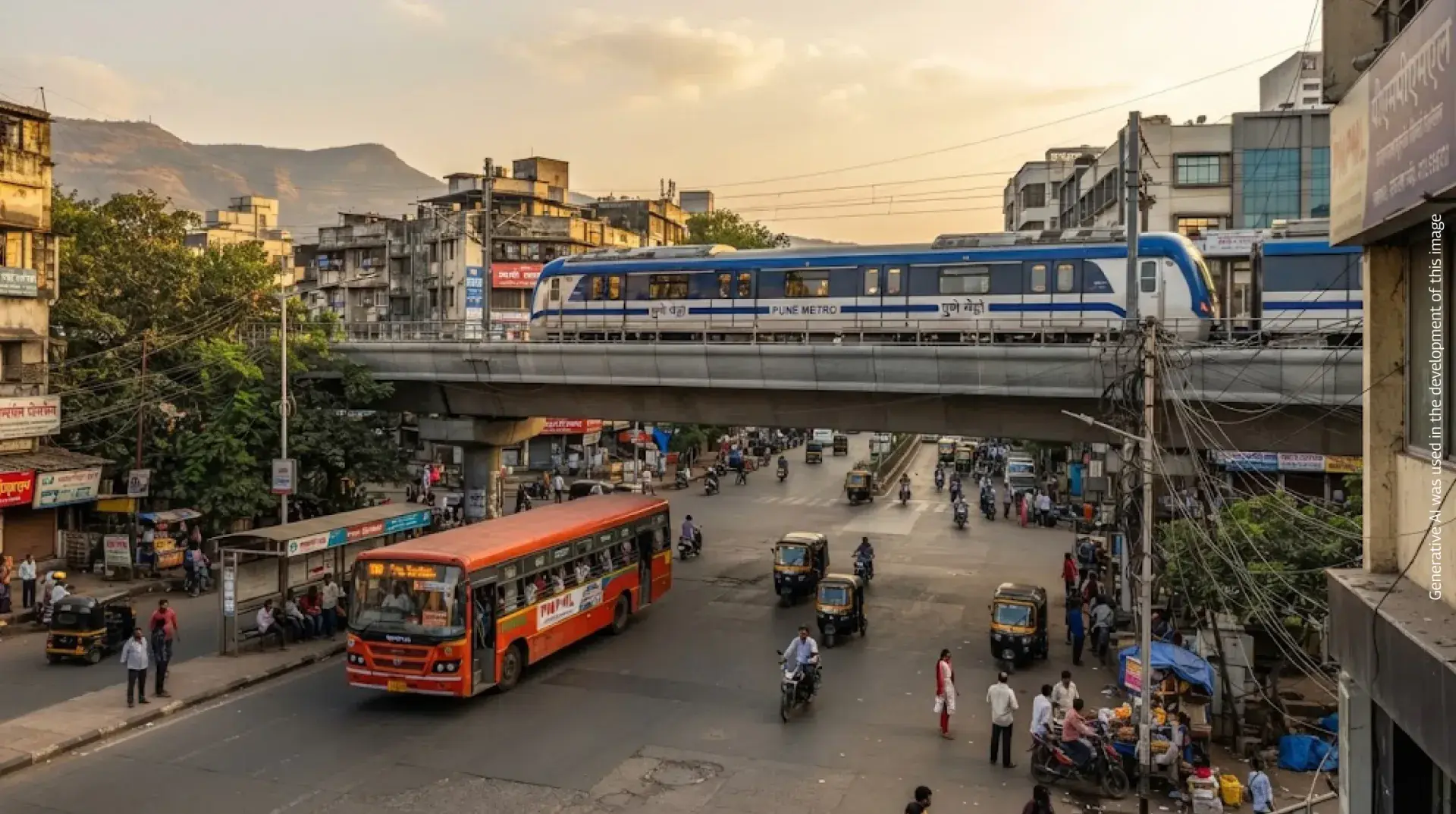
Pune has always been a city on the move. From its thriving IT parks and educational institutions to its rapidly expanding residential neighbourhoods, the city continues to attract professionals, entrepreneurs, students, and families from across the country.
However, Pune's growth has also created a challenge that almost every resident experiences daily—commuting.
Whether you're travelling from Hinjawadi to Shivajinagar, Kharadi to Pune Station, Baner to Civil Court, or Pimpri-Chinchwad to the city's commercial hubs, traffic congestion can significantly affect travel time and daily productivity.
This is where public transportation plays a crucial role.
With the expansion of the Pune Metro and the continued importance of PMPML bus services, commuters today have multiple options for navigating the city. As a result, an increasingly common question is emerging among residents and homebuyers alike:
When comparing Pune Metro vs bus services, which option actually saves more time, money, and effort in 2026?
The answer goes beyond ticket prices. It also reveals how transportation infrastructure is influencing lifestyle choices, residential demand, and the future growth of Pune.
Pune's transformation into one of India's leading economic centres has significantly increased mobility requirements.
The city now supports major employment hubs in:
As employment opportunities have expanded across multiple corridors, commuting distances have grown as well.
At the same time, Pune continues to witness a rise in private vehicle ownership. Recent reports indicate that the city added more than three lakh new vehicle registrations in 2025 alone. While this reflects economic growth, it also places increasing pressure on existing road infrastructure.
For many residents, daily travel is becoming less about distance and more about predictability.
A journey that appears to take 20 minutes on a map can easily extend to an hour during peak traffic periods. This growing challenge is encouraging more commuters to evaluate public transportation alternatives that offer reliability alongside affordability.
Before diving deeper, here's a snapshot of how both systems compare.
| Factor | Pune Metro | PMPML Bus |
|---|---|---|
| Travel Time Reliability | High | Moderate |
| Traffic Dependency | No | Yes |
| Route Coverage | Limited to Metro Corridors | Extensive Citywide Coverage |
| Peak Hour Efficiency | High | Moderate |
| Last-Mile Connectivity | Moderate | Strong |
| Travel Comfort | High | Varies |
| Expansion Potential | Significant | Moderate |
| Impact on Nearby Property Demand | Strong | Limited |
| Best For | Office Commuters & Long Routes | Local & Neighbourhood Travel |
Both transportation systems serve different purposes and often complement each other rather than compete directly.
One of the biggest differences in the PMPML vs Metro debate comes down to time.
Most commuters assume travel distance determines journey duration. In reality, traffic conditions often have a much greater impact.
Road-based transport remains vulnerable to:
Metro networks eliminate many of these variables because trains operate on dedicated corridors. For daily commuters, the biggest benefit isn't necessarily speed—it's consistency. Knowing that a commute will reliably take 25 minutes every day can significantly improve planning, reduce stress, and increase productivity.
For professionals working in time-sensitive environments, predictable travel often becomes more valuable than occasional time savings.
Most discussions around transportation focus on ticket prices.
However, the true cost of commuting extends far beyond fares.
Daily travel affects:
Consider a commuter who saves just 30 minutes each working day by using a more efficient travel option.
Over a year, that translates into nearly 180 hours saved—equivalent to more than seven full days. This is one reason why infrastructure projects often influence residential demand. People increasingly seek homes that reduce commuting burdens rather than simply minimise distances.
When analyzing Pune's urban transit costs, many commuters discover that both the Pune Metro and PMPML bus networks remain remarkably economical compared to the high overhead of private vehicle ownership. However, the core question for daily commuters goes beyond basic ticket pricing—it focuses on overall travel efficiency, predictability, and long-term value.
To evaluate everyday transit costs, here is how the minimum and maximum token ticket pricing structures compare across both systems:
| Transit System | Minimum Fare (Short Distance) | Maximum Fare (Long Distance) | Primary Ticketing Options | Data Source Reference |
|---|---|---|---|---|
| Pune Metro | ₹10 (0–2 km) | ₹50 (18+ km) | Tokens, QR Tickets, One Pune NCMC Smart Card | Maha Metro Fare Guide |
| PMPML Buses | ₹10 (Base Stage) | Distance-based / Stage slabs | Cash tickets, Daily Passes (₹70–₹150), Monthly Passes | Pune Municipal Corporation |
The future of public transportation in Pune is no longer a debate of choosing between the metro and buses. Instead, successful urban mobility relies entirely on multimodal integration.
By combining the speed and reliability of the metro with the expansive reach of PMPML buses, commuters unlock the most efficient, connected, and stress-free travel experience across the metropolitan region.
| Consideration | Metro User | Bus User |
|---|---|---|
| Travel Predictability | High | Moderate |
| Exposure to Traffic Delays | Low | High |
| Daily Stress Levels | Lower | Higher |
| Dependence on Private Vehicles | Lower | Moderate |
| Connectivity to Employment Hubs | Strong | Route Dependent |
| Overall Convenience | High | Moderate |
For many professionals, the metro's greatest advantage lies not in cost savings but in consistency and reliability.
A decade ago, homebuyers primarily focused on:
In 2026, connectivity has become equally important.
The rise of hybrid work, longer commuting distances, and increasing traffic congestion has changed how people evaluate residential locations. Many buyers now assess homes based on how much commuting time they can save over the next decade.
This shift has elevated metro connectivity from a desirable feature to a significant decision-making factor.
One of the most important outcomes of Pune Metro's expansion is the emergence of new growth corridors across the city.
Improved transportation infrastructure is helping reduce perceived travel distances and making several residential destinations more attractive.
Eastern Pune, for example, continues to witness strong residential demand because of its proximity to major IT and commercial hubs. Homebuyers exploring premium homes in Kharadi Annex increasingly value locations that provide easy access to workplaces while benefiting from ongoing infrastructure improvements.
Similarly, Pimpri-Chinchwad is witnessing growing residential interest as metro connectivity improves accessibility across the region.
As a result, infrastructure is no longer simply supporting development—it is actively driving it.
Across major urban centers in India, rapid mass transit infrastructure has consistently transformed residential growth patterns. Pune is currently experiencing a powerful structural shift driven by this exact transit-led evolution.
As modern transit networks connect outer pockets with key employment zones, micro-markets situated near major rail and metro corridors unlock distinct residential advantages:
These compounding factors explain why transit-adjacent residential communities—such as Mahindra Citadel in Pimpri-Chinchwad, strategically positioned right next to the Sant Tukaram Metro Station—continue to see robust interest from contemporary homebuyers and long-term investors alike.
| Homebuyer Priority | Importance in 2026 |
|---|---|
| Connectivity to Employment Hubs | Very High |
| Reduced Commute Time | Very High |
| Public Transport Access | High |
| Infrastructure Development | High |
| Schools & Healthcare Access | High |
| Lifestyle Amenities | High |
| Carpet Area Alone | Moderate |
| Luxury Features Alone | Moderate |
The table reflects a broader reality: connectivity has become one of the strongest drivers of modern housing demand.
The future of Pune's public transport network is increasingly being shaped by multimodal integration. To build a cohesive, efficient urban ecosystem and curb heavy reliance on private vehicles, ongoing municipal and state investments are heavily focused on:
For daily commuters, this evolution translates to greater flexibility, reduced road congestion, and much smoother travel experiences across the metropolitan region.
Choosing the ideal transit mode depends heavily on your specific route, departure point, and destination:
When evaluating overall value, however, modern commuters increasingly prioritize time savings and predictability over minor fare differences. Avoiding highway bottlenecks through transit-oriented living significantly enhances daily quality of life and productivity.
The debate around Pune Metro vs bus is about more than choosing a transport mode.
It reflects a larger transformation occurring across Pune.
As metro networks expand and transportation infrastructure improves, connectivity is becoming one of the strongest influences on residential demand and urban development.
Whether it is the growing residential appeal of Kharadi Annex or the increasing popularity of metro-connected communities in Pimpri-Chinchwad, homebuyers are recognising the long-term advantages of living in well-connected locations.
Projects such as Mahindra IvyLush and Mahindra Citadel reflect this evolving preference for homes that combine lifestyle, accessibility, and future-ready infrastructure.
For homebuyers, investors, and daily commuters alike, one thing is becoming increasingly clear: in Pune's next phase of growth, connectivity will continue to be one of the city's most valuable assets.
Disclaimer: This article is for informational purposes only and should not be considered travel, financial, legal, investment, or professional advice. Information related to Pune Metro operations, PMPML bus services, fares, travel times, routes, infrastructure projects, and public transport schedules is subject to change. Readers are advised to verify the latest information with Pune Metro, PMPML, and relevant government authorities before planning their journey or making any travel, property, or investment related decisions.
For routes covered by metro corridors, Pune Metro generally offers more predictable and often faster travel times because it operates independently of road traffic.
Metro focuses on speed and reliability, while PMPML provides wider route coverage and stronger neighbourhood connectivity.
Both are affordable public transport options. A Pune metro fare comparison typically shows that the cost difference is relatively small for most daily commuters.
Metro connectivity can reduce commute times, improve accessibility, and enhance long-term convenience, making such locations increasingly attractive.
Improved transportation infrastructure often enhances accessibility and liveability, which can support stronger residential demand over time.

Established in 1994, Mahindra Lifespace Developers Ltd. (‘Mahindra Lifespaces’) brings the Mahindra Group’s philosophy of ‘Rise’ to India’s real estate and infrastructure industry through thriving residential communities and enabling business ecosystems.


