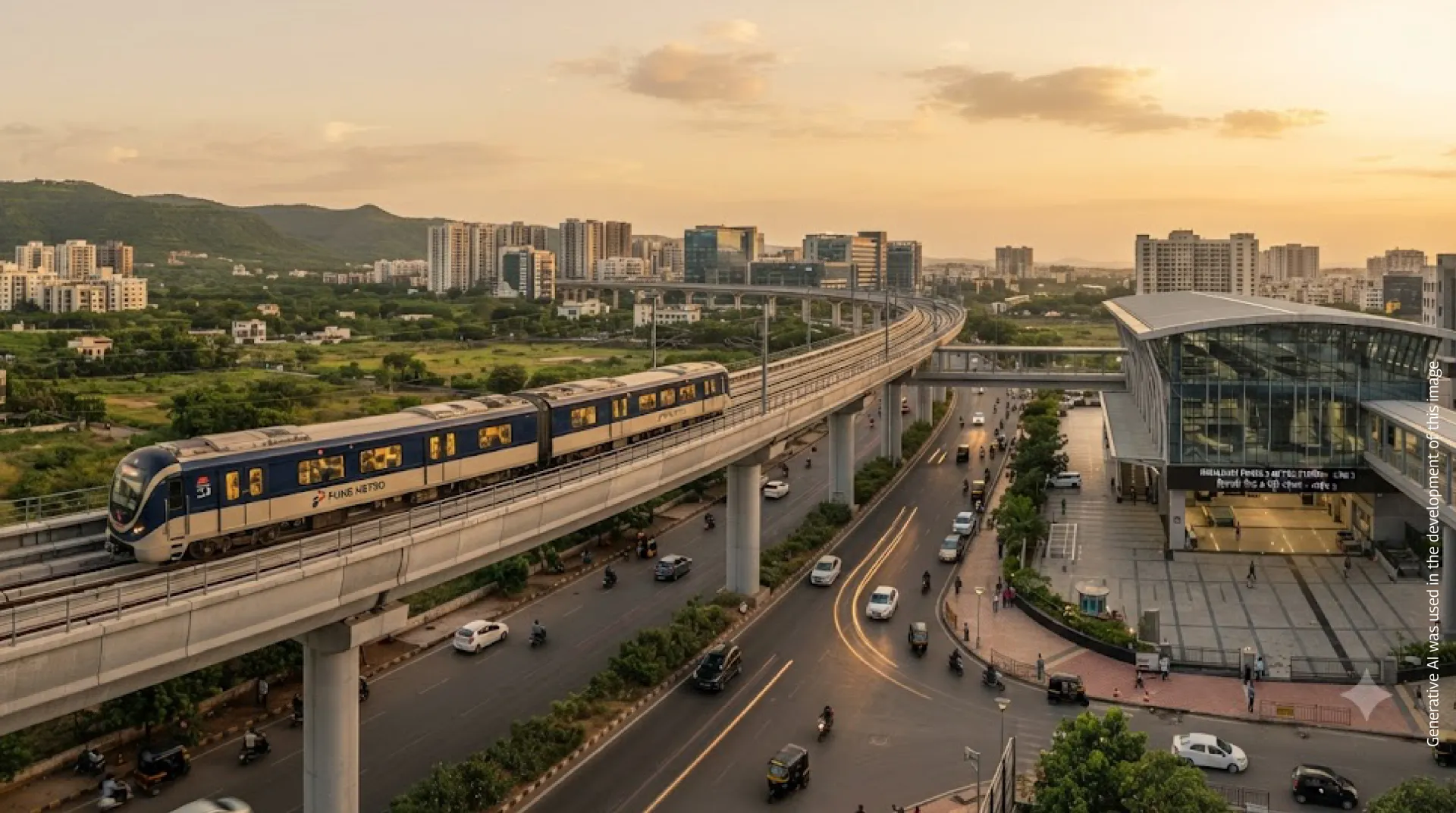
Pune’s rapid urban growth has transformed the city into one of India’s largest IT and residential hubs. However, along with this growth came increasing traffic congestion, longer commute times, and rising pressure on road infrastructure — especially across the Hinjewadi IT corridor.
For years, daily travel between Hinjewadi and central Pune has been one of the biggest challenges for working professionals. Long traffic jams, unpredictable travel durations, and peak-hour congestion have made commuting stressful for lakhs of residents travelling to and from the city’s major employment zones.
The upcoming Pune metro Hinjewadi route is expected to significantly improve this situation by offering faster, more reliable, and better-connected urban mobility.
The metro corridor is not only an important transportation project but also a major catalyst for infrastructure-led development across Pune. Areas connected to the Pune Hinjewadi metro are already witnessing stronger residential demand, improved connectivity planning, and rising interest from both homebuyers and investors.
As metro accessibility becomes an increasingly important factor in property buying decisions, locations near key stations are emerging as some of Pune’s most promising growth corridors.
In this guide, we’ll explore:
The Pune metro Hinjewadi route, also known as Pune Metro Line 3, is among Pune’s most important urban infrastructure developments.
The corridor is designed to connect:
The metro line spans approximately 23.3 km and is expected to include 23 stations connecting major IT hubs, residential neighbourhoods, commercial districts, and educational zones.
The route primarily focuses on improving connectivity between Pune’s western suburbs and central business districts, especially benefiting professionals working in the Rajiv Gandhi Infotech Park and nearby commercial clusters.
The project is also expected to integrate with other metro corridors, creating a more connected and efficient public transportation network across Pune.
The Pune Hinjewadi metro is expected to play a major role in reshaping both mobility and urban development across Pune.
Hinjewadi is home to some of Pune’s largest IT parks, multinational companies, startups, and business campuses. Lakhs of professionals travel to this region every day from different parts of the city.
The metro corridor is expected to improve accessibility to these employment zones and reduce dependency on road-based commuting.
Road congestion between Hinjewadi, Wakad, Baner, and Shivajinagar has been a persistent challenge for daily commuters.
The metro is expected to offer:
Large-scale infrastructure projects often accelerate development in surrounding areas. The Pune metro Hinjewadi route is already influencing:
Public transport systems help reduce dependence on private vehicles, which can contribute to lower congestion and improved urban sustainability over time.
The metro corridor will pass through several important residential, commercial, and institutional zones across Pune.
# | Station Name | Key Area/Landmark Served |
1 | Megapolis Circle | Gateway to Hinjawadi IT Park |
2 | Embassy Quadron Business Park | Major IT/Office Cluster |
3 | Dohler | Tech Park Zone |
4 | Infosys Phase II | Major IT Campus |
5 | Wipro Phase II | Corporate IT Headquarters |
6 | Pall India | Commercial District |
7 | Shivaji Chowk | Hinjawadi Residential Belt |
8 | Hinjewadi | Central IT Hub |
9 | Wakad Chowk | Commercial & Residential Junction |
10 | Balewadi Stadium | Shiv Chhatrapati Sports Complex |
11 | NICMAR | Educational Institutions Zone |
12 | Ram Nagar | Established Residential Locality |
13 | Laxmi Nagar | Growing Residential Area |
14 | Balewadi Phata | Highway Junction |
15 | Baner Gaon | Transit Corridor |
16 | Baner | Major Residential & Commercial Hub |
17 | Krushi Anusandhan | Agricultural Research Center |
18 | Sakal Nagar | Media/Corporate Offices |
19 | University | Pune University Campus Vicinity |
20 | R.B.I. | Financial District / Bhosalenagar |
21 | Agriculture College | Educational Hub |
22 | Shivaji Nagar | Interchange with Purple/Aqua Lines |
23 | Civil Court | Primary City Interchange (Purple/Aqua) |
This metro line concludes at Shivaji Nagar and Civil Court, providing critical connectivity to the operational Purple and Aqua lines of the Pune Metro network.
This line is specifically designed to provide a "15-minute" transit experience for IT professionals, potentially reducing a 90-minute road commute to roughly 40-45 minutes.
Areas like Baner, Balewadi, and Wakad are expected to see the highest appreciation in property values and rental demand as this line moves toward full commercial operations.
For thousands of professionals travelling between Hinjewadi and central Pune every day, commuting has long been one of the biggest challenges of city life. Peak-hour traffic on the Mumbai-Pune Highway and internal roads around the IT corridor often leads to unpredictable travel times and daily stress.
The upcoming Pune Hinjewadi metro is expected to bring a significant shift in how people travel across the city
At present, many office-goers travelling to Hinjewadi face:
For professionals working in Hinjewadi’s IT parks, even relatively short distances can sometimes take well over an hour during rush hours.
Once operational, the Pune metro Hinjewadi route is expected to make everyday commuting more structured and efficient.
The metro corridor will improve access between Hinjewadi, Baner, Balewadi, Shivajinagar, and surrounding commercial areas.
Unlike road traffic, metro travel offers greater consistency, helping commuters better plan their schedules.
With improved public transport access, many professionals may gradually shift away from daily car or cab usage.
Saving time on daily travel can positively impact lifestyle, family time, and overall convenience for working professionals.
Infrastructure has always played an important role in shaping real estate growth, and metro connectivity is now becoming one of the biggest influencing factors for homebuyers in Pune.
Homebuyers today are not only evaluating:
They are also considering:
This shift is becoming increasingly visible across locations connected to the Pune metro Hinjewadi route.
Hinjewadi remains one of Pune’s largest employment hubs and continues to attract strong residential demand from:
Metro connectivity is expected to further strengthen the area’s residential and rental demand.
Wakad has emerged as a preferred residential destination because of its connectivity and growing social infrastructure.
The locality benefits from:
Baner continues to witness premium residential growth due to its balanced urban lifestyle, commercial activity, and accessibility to business hubs.
The metro corridor is expected to further improve connectivity across the area.
Balewadi is rapidly developing into a mixed-use urban destination with strong commercial and residential growth potential.
Its connectivity to both Hinjewadi and central Pune makes it an important location along the metro route.
Across major Indian cities, metro infrastructure has historically contributed to increased residential demand and stronger property value appreciation.
Locations near metro stations often benefit from:
As infrastructure projects move closer to completion, homebuyer confidence and investor activity typically increase across connected micro-markets.
The Pune Hinjewadi metro corridor is expected to create similar long-term development opportunities. Properties within a 1 km walking radius of the Hinjewadi or Balewadi stations will most likely see a 10–15% higher rental demand compared to those requiring feeder transport.
The Pune metro Hinjewadi route is not developing in isolation. The corridor is also driving broader infrastructure improvements across western Pune.
Several surrounding areas are witnessing parallel growth in:
To support rising traffic movement and improve connectivity, multiple junction upgrades, flyovers, and road expansion projects are underway across key stretches.
The metro corridor is strengthening demand for:
This is especially important for areas connected to Pune’s IT ecosystem.
As residential demand rises near metro-connected locations, supporting infrastructure is also expanding, including:
Across major cities, homebuyers are increasingly choosing locations that offer better public transport access and shorter commute times. Pune is now witnessing a similar transition.
Metro connectivity is gradually becoming one of the important factors influencing residential preferences, especially among working professionals and young families. For the thousands of professionals trapped in daily Hinjewadi gridlock, the Pune metro line 3 isn't just a transport project—it’s the return of their personal time.
The growing impact of the Pune metro Hinjewadi route is also being observed closely by industry bodies such as CREDAI Pune.
Across Pune, developers are increasingly aligning future residential planning with:
This reflects the broader shift toward infrastructure-driven real estate growth across the city.
While the metro corridor is expected to improve connectivity significantly, large-scale infrastructure projects also come with certain challenges.
Infrastructure projects of this scale often experience execution and approval-related delays.
Efficient feeder services and local transport integration will play an important role in improving commuter convenience.
As residential and commercial demand increases around metro corridors, sustainable urban planning will become increasingly important.
Despite these challenges, the long-term growth outlook for metro-connected regions remains strong.
The Pune metro Hinjewadi route is expected to play a transformative role in Pune’s future urban development.
From improving daily commuting convenience to influencing residential demand and infrastructure growth, the corridor is becoming one of Pune’s most important development drivers.
As metro connectivity continues to shape homebuyer preferences, metro-linked residential communities are likely to remain central to Pune’s long-term growth story.
For homebuyers, professionals, and investors alike, understanding infrastructure-led growth trends today can help make more informed real estate decisions for the future.
Disclaimer - This content is for educational and informational purposes only and does not constitute financial, legal, or professional advice. Please consult with a certified professional or legal counsel before making any decisions based on this information.
1. What is the Pune Metro Hinjewadi route?
The Pune metro Hinjewadi route connects Megapolis Circle in Hinjewadi to Civil Court in Shivajinagar through a 23.3 km elevated metro corridor.
2. How many stations are there on the Pune Hinjewadi Metro?
The corridor is expected to include 23 stations connecting important residential, commercial, and IT hubs.
3. Which areas will benefit from Pune Metro Line 3?
Hinjewadi, Wakad, Baner, Balewadi, and Shivajinagar are among the major areas expected to benefit from improved connectivity.
4. Will Pune Metro impact property prices?
Metro connectivity has historically contributed to stronger residential demand and infrastructure-led property appreciation in several Indian cities.
5. Why is the Hinjewadi metro corridor important?
The corridor improves connectivity between Pune’s largest IT hub and central Pune, helping reduce commute challenges for daily travellers.
6. How does metro connectivity influence homebuying decisions?
Many homebuyers now prioritise metro accessibility because it improves commute convenience, rental demand potential, and long-term connectivity advantages.

Established in 1994, Mahindra Lifespace Developers Ltd. (‘Mahindra Lifespaces’) brings the Mahindra Group’s philosophy of ‘Rise’ to India’s real estate and infrastructure industry through thriving residential communities and enabling business ecosystems.


