Our Carbon Neutrality Journey
Climate Strategy
Our climate strategy is rooted in a lifecycle approach, measuring and reducing greenhouse gas emissions from design, demolition and construction through to the operations phase.
Our climate strategy is anchored in a three-step approach:
- Reducing demand through climate-responsive design (CRD)
- Enhancing energy efficiency
- Integrating renewable energy solutions.
Our approach goes beyond offsets and targets direct emission reduction across our operations and supply chain. We believe in tackling the root cause through reductions rather than relying on carbon credit programmes. This intentional shift reflects our commitment to creating a real, measurable impact and building a low-carbon future from the ground up.
MLDL's Sustainability Focus Areas (Residential business) | ||
|---|---|---|
| Group Ambition: Global ESG Leader | Vision: Together we Rise | |
| for Planet Positive | ||
| Greening Ourselves | Decarbonising Our Industries (addressing Scope 3) | Rejuvenating Nature |
| 1. Net zero on scope 1+2 emissions (Energy efficiency and green energy) | 4. Green portfolio transition (100% Green certified buildings → shift towards net zero buildings) | 7. Promoting regenerative agriculture (via improved farming techniques) |
| 2. Net Zero on water and waste (Reduce – water demand (e.g., use curing compound, rainwater harvesting & use) Reuse – treated wastewater, C&D waste Recycle – wastewater, C&D waste) | 5. Net zero transition - suppliers support (Micro-solutions for suppliers via DBC² & MTCoE³; for contractors – energy efficiency e.g., use of electric concrete pumps replacing diesel, etc.) | 8. Afforestation (Landscaping & planting for a green community) |
| 3. Material circularity (e.g., GGBS¹/fly ash replaces cement in concrete, use of secondary steel, aluminium formwork with multiple reuse) | 6. Industry circularity (e.g., auto recycling) | 9. Biodiversity conservation (Site flora and fauna preservation & restoration) |
Enablers | ||||
|---|---|---|---|---|
| Leading on reporting & disclosures | Incubator for green technology | Leadership positioning through communication | Active voice for climate advocacy | Practical capability building plan |
Notes: (1) GGBS: Ground-granulated blast-furnace slag | (2) DBC: Decarbonisation Business Charter | (3) MTCoE: Mahindra TERI Centre of Excellence
Our climate action strategy is built on two pillars – Focus inward
- Establishing and updating annually a robust GHG emissions inventory
- Monitoring operational energy and resource consumption
- Transparency in GHG reporting aligned with global frameworks (CDP, TCFD) Focus outward
- Driving industry transformation through collaborations and partnerships
- Knowledge-sharing and solution co-creation for decarbonising the built environment
Carbon Neutrality Action Plan
Residential
| Action | Progress Status |
|---|---|
| Office Design: Design EPI – thermal and visual comfort | Developed and integrated guidelines for:
|
| Measurement and monitoring |
|
| Behavioural | Sensitisation done through:
|
Energy efficiency
| Action | Progress Status |
|---|---|
| Lighting: LED, lighting control, sensors | Identified and implemented energy-saving ideas for efficient lighting and cooling, such as:
|
| Efficient DGs |
|
Integration of renewable energy
| Action | Progress Status |
|---|---|
| On-site rooftop solar PV – on 3 Sales Galleries:
|
| Tree plantation | 2,200 trees planted as part of ESOP activities, offsetting 55 tCO₂e |
B. Product
Purchased goods and services
| Action | Progress Status |
|---|---|
|
|
| Supplier energy efficiency initiatives |
|
Use of sold goods
| Action | Progress Status |
|---|---|
| Design energy performance index – Building envelope |
|
| Switch to PNG for all feasible projects |
|
| Renewable for common area up to 100% |
|
| Customer energy efficiency |
|
Employee commute
| Action | Progress Status |
|---|---|
| EV |
|
| Work from home |
|
| Cycling/walk |
|
Business travel
| Action | Progress Status |
|---|---|
|
|
|
Waste management
| Action | Progress Status |
|---|---|
| Zero Waste to Landfill (ZWL) |
|
| ZWL for sites |
|
| ZWL for residential homes |
|
IC & IC
A. Admin/Project Offices and Common Area
Demand reduction
| Action | Progress Status |
|---|---|
| Office Design: Design EPI – thermal and visual comfort |
|
| Measurement and monitoring |
|
| Behavioural | Sensitisation done through:
|
Energy efficiency
| Action | Progress Status |
|---|---|
|
|
Integration of renewable energy
| Action | Progress Status |
|---|---|
|
|
|
|
Offsets
| Action | Progress Status |
|---|---|
| Tree plantation |
|
B. Common Area (and Industrial Customers)
Purchased goods and services
| Action | Progress Status |
|---|---|
|
|
| Supplier energy efficiency initiatives |
|
Use of sold goods
| Action | Progress Status |
|---|---|
| Design energy performance index – Building envelope |
|
| Switch to PNG for all feasible projects |
|
| Renewable for common area up to 100% |
|
| Customer energy efficiency |
|
Employee Commute
| Action | Progress Status |
|---|---|
| EV |
|
| Work from home |
|
| Cycling/walk |
|
Business travel
| Action | Progress Status |
|---|---|
| EV |
|
| Work from home |
|
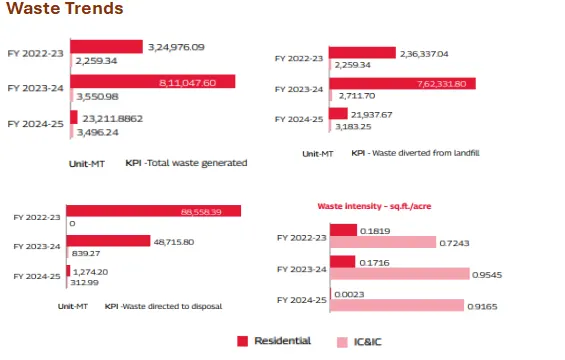
Waste management
| Action | Progress Status |
|---|---|
|
|
GHG Emission Trends
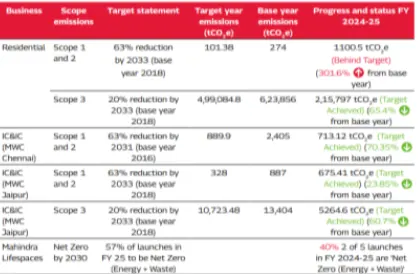
To tackle the impact of our business and operations, we recognise the importance of measuring and disclosing Scope 1, 2, and 3 GHG emissions across all our businesses.
Note:
Scope 3 emission intensity considered here for IC, and IC is aligned to SBT and excludes Scope 3 Category: Use of Sold Goods.
Scope 1 includes emissions from fuel consumption, including diesel generators at the project office, sales gallery, and utilities, as well as water discharge and treatment at industrial customers, project offices, and sales galleries.
Scope 2 includes emissions from electricity purchased from the grid for project offices and sales galleries.
Scope 3 includes emissions from:
- Category 1: Purchased goods and services
- Category 4: Upstream transportation and distribution
- Category 5: Waste generated in operations
- Category 6: Business travel
- Category 7: Employee commute
- Category 8: Upstream leased assets
- Category 11: Use of sold products
- Category 13: Downstream leased assets
GHG emission reduction
Impacted SDGs:

| Initiative category | Initiative type | Annual savings (tonnes) | Avoided emission (tCO₂e) | Annual monetary savings (₹ Lakh) |
|---|---|---|---|---|
| Material optimisation | Embodied carbon reduction | 811 | 391 | 103 |
Varied emission reduction initiatives with associated impact can be found here.
Initiatives and Impact - Energy, Water, Waste & Others - FY 25
Target and Progress