

Clean Construction And Good Health
Air Quality Monitoring and Management
Real-time air quality monitoring for proactive action
Air pollution, which is both ambient and indoor, is one of the most significant environmental health risks globally. Recognising this, we actively monitor and manage air quality across our project sites to safeguard workers’ health and community well-being.
To strengthen our air quality management efforts, we developed in-house air pollution mitigation guidelines aligned to local regulations and even deployed real-time AQI monitors across our sites in Gurugram, Mumbai, Bangalore, and Pune, going beyond regulatory requirements. These monitors track key pollutants and feed data to a centralised dashboard, enabling quick analysis and action. The dashboard is reviewed monthly by senior leadership, including the CEO, ensuring top-level oversight and swift decision-making.
Residential
| Construction Stage | Occupancy Stage |
|---|---|
| Strategic Interventions | |
|
|
| Reference Materials | |
|
|
| Impact | |
|
|
IC & IC
| Development Stage | Operation and Maintenance Stage |
|---|---|
| Strategic Interventions | |
|
|
| Reference Materials | |
|
|
| Impact | |
|
|
Air Quality and Point Source emission Trends
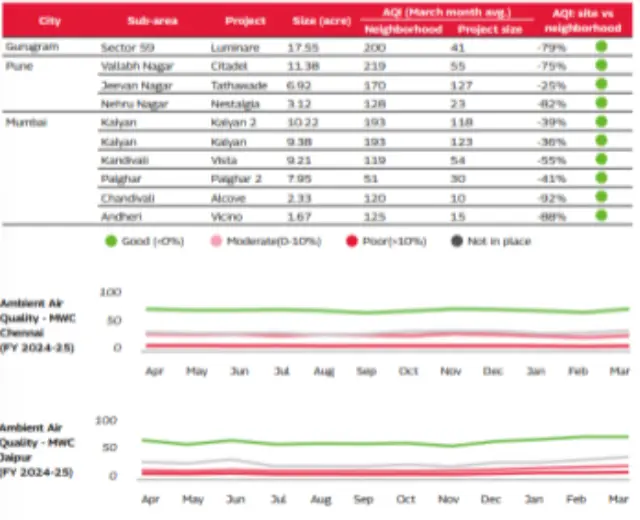
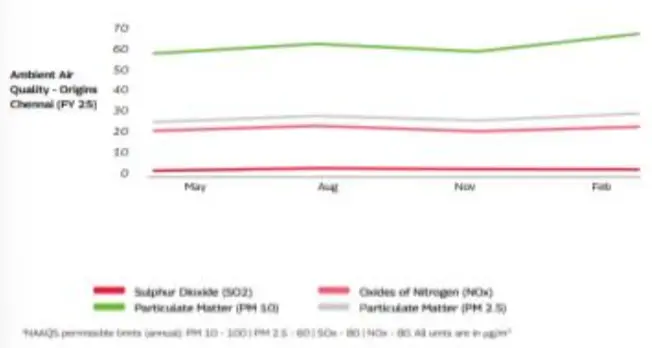
Point Source emission Trends
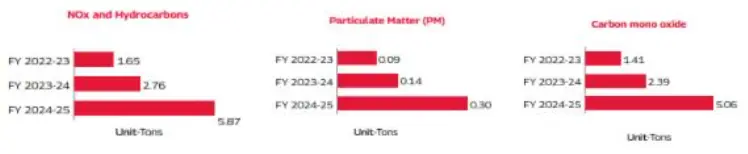
Unit-tonnes (refer the above image)
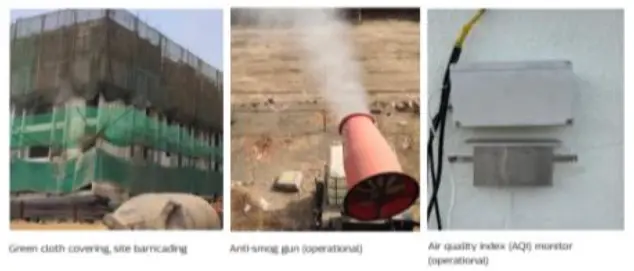
Air quality improvement measures
Multiple mitigation measures taken on-site during the construction phase include but are not limited to –
India Alliance for Clean Construction (IACC)
To promote clean construction practices, we signed up for the India Alliance for Clean Construction (IACC) programme by WRI India, which brings together stakeholders from the construction industry to drive clean-air-focused practices in construction, where reducing emissions and controlling dust are central to project planning and execution. Apart from this, we initiated work with CEEW (Council on Energy, Environment and Water) as part of their Clean Air and Good Health (CABH) programme and are working across the Kalyan 2 project. These outcomes affirm our on-ground control measures and support our broader health and sustainability objectives.
Tackling dust pollution through in-house innovation: Automated Wheel Washing System
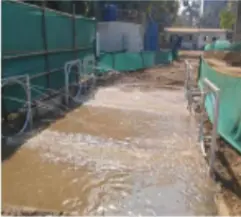
Construction activities generate large volumes of dust and debris, particularly from the constant movement of trucks and heavy vehicles entering and exiting the site. These vehicles often carry mud and particulate matter on their wheels, which later dislodges onto public roads, raising air pollution (PM levels), contaminating nearby soil, and creating health and safety risks.
To address this, at Mahindra Citadel we implemented an in-house automated wheel washing system, a value-engineered solution designed, fabricated, and operated entirely on-site. The system comprises six circular washing rings fitted with eight high-pressure nozzles each, aligned to target vehicle wheels precisely. Wastewater is collected in a sedimentation tank, filtered via a baffle system, and reused through a 3-phase pump, ensuring minimal water wastage.
| Vehicle positioned at the wheel washing area. | An automated wheel washing system is operated; clean water from the water tank is used. | After the vehicle is washed, water collects in the designated area and flows through a 150 mm pipe positioned 50 mm above floor level. | The Baffle wall in the water tank separates soil from the water, allowing the soil to settle down and leaving clean water for reuse. | Through this pipe, water flows to the water tank attached to the wheel wash area. |
Annual cost savings → ~ ₹ 1.5 Lakh
This initiative has led to a measurable reduction in dust-related air pollution, prevented regulatory penalties, and delivered cost savings of ₹1.5 lakh annually. The model is now scalable across sites, aligning with broader sustainability and compliance goals.