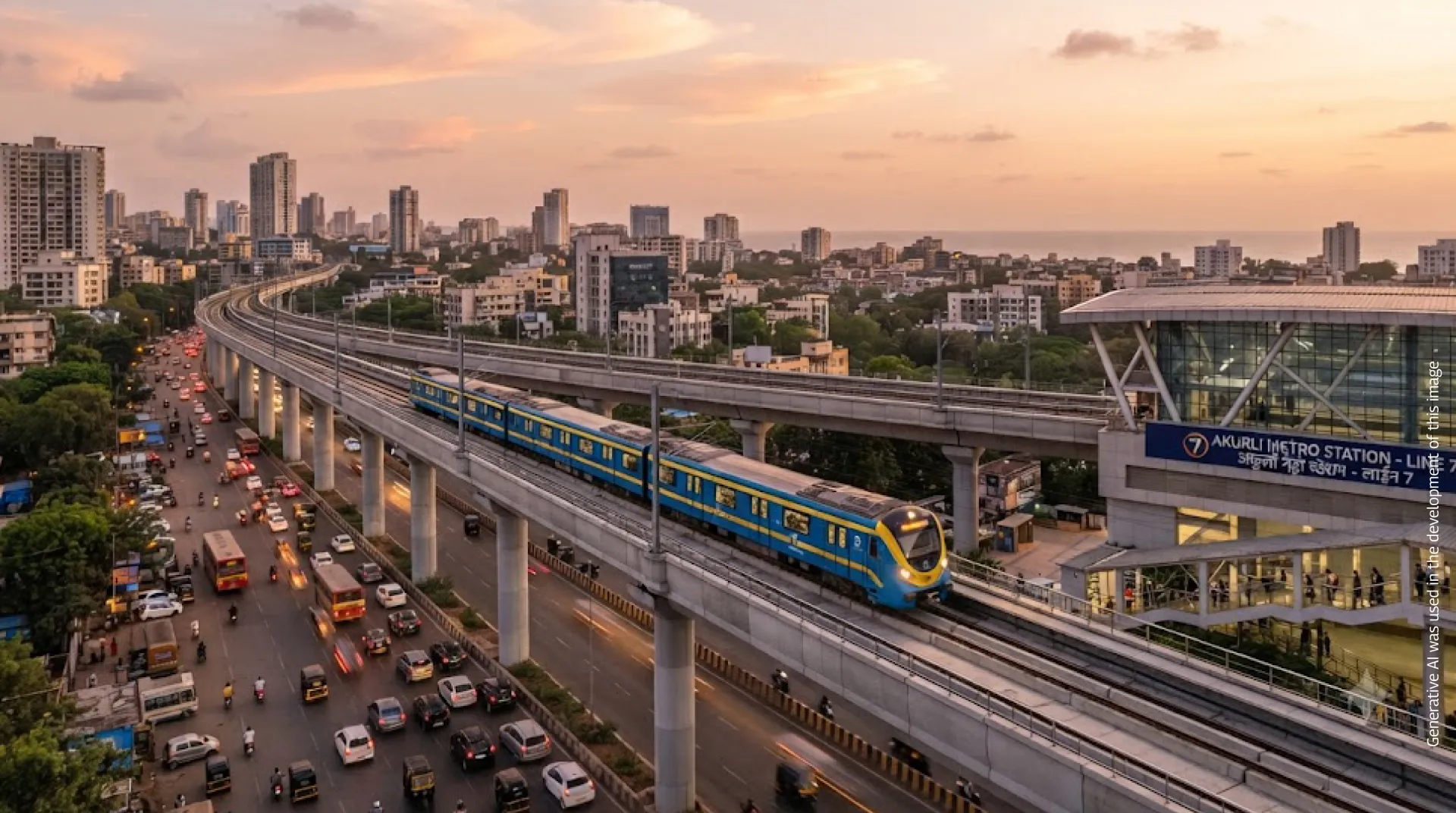
A few years ago, homebuyers evaluating properties in Kandivali East focused primarily on apartment size, amenities, parking availability, and builder reputation. While those factors still matter, metro connectivity has rapidly become one of the biggest decision drivers of homebuying.
The reason is simple. In Mumbai, connectivity often shapes lifestyle as much as the home itself. A difference of 20-30 minutes in daily travel can significantly impact work-life balance, convenience, and even long-term property demand.
This is where Mumbai Metro Line 7 has changed the equation. Running along the Western Express Highway corridor, the line has improved connectivity across Mumbai's western suburbs and reduced dependence on unpredictable road travel.
For Kandivali East, the impact goes beyond shorter commutes. Better connectivity is influencing homebuyer preferences, attracting more residential demand, strengthening rental markets, and enhancing the area's long-term appeal among investors.
But is Metro Line 7 actually affecting property rates in Kandivali East? And what should homebuyers and investors know before making a decision in 2026?
Let's take a closer look.
Factor | Impact on Kandivali East |
Metro Connectivity | Significantly Improved |
Access to Employment Hubs | Faster and More Predictable |
Homebuyer Demand | Increasing |
Rental Demand | Growing |
Commute Convenience | Enhanced |
Residential Development Activity | Strengthening |
Long-Term Investment Appeal | Improving |
Overall Liveability | Enhanced |
Across major cities worldwide, transportation infrastructure has consistently influenced real estate demand. The same trend is now visible across Mumbai's metro-connected corridors.
When the location becomes easier to access, more people consider living there. As demand rises, property values and rental interest often follow.
Metro connectivity contributes to increased residential demand because it:
For today's homebuyers, connectivity is no longer viewed as a bonus feature. It is often one of the primary factors influencing location choice.
Urban transport infrastructure projects like Mumbai Metro Line 7 are part of India’s broader push toward sustainable, transit-oriented urban development, as highlighted in national urban mobility and infrastructure planning frameworks by NITI Aayog.
Metro Line 7, also known as the Red Line, runs from Andheri East to Dahisar East as of today, largely following the Western Express Highway corridor.
The operational stations on Metro Line 7 include:
For residents of Kandivali East, metro line 7 is particularly important because it improves access to key commercial districts, educational institutions, and healthcare facilities.
For many daily commuters, Metro Line 7 has transformed journeys that previously depended heavily on road traffic. The result is a more reliable and efficient travel experience across Mumbai's western suburbs.
Kandivali East has evolved considerably over the past decade.
Once viewed primarily as a residential suburb, it is increasingly being recognised as a well-connected urban neighbourhood supported by infrastructure, social amenities, and employment accessibility. Several factors have contributed to this transformation.
Together, these factors have strengthened Kandivali East's position as one of Mumbai's more attractive residential markets.
Many people assume that property prices automatically increase when a metro line becomes operational. In reality, the process is more gradual. Metro connectivity influences property values through a chain reaction:
This is why infrastructure projects often have a lasting impact on residential markets rather than creating only short-term price movements.
One of the biggest mistakes investors make is assuming all metro-connected locations perform equally. They don't. What makes Kandivali East particularly interesting is that its growth story is not dependent solely on Metro Line 7.
The locality already benefits from:
In many emerging suburbs, metro connectivity arrives before social infrastructure develops. Kandivali East is different. The area already functions as a mature residential destination. Metro connectivity is enhancing an existing ecosystem rather than creating one from scratch.
This often creates a stronger foundation for sustainable long-term demand.
Not all residential pockets experience the same level of demand.
Areas that combine:
typically attract stronger homebuyer interest.
This explains why today's homebuyers increasingly evaluate the complete neighbourhood ecosystem rather than simply measuring distance from a metro station. Connectivity remains important, but convenience across multiple aspects of daily life often drives long-term desirability.
The short answer is yes. However, the premium varies based on several factors.
This is why two projects located near the same metro corridor can perform very differently in the market.
This is one of the most overlooked aspects of infrastructure-led real estate growth. Being near a metro station alone does not guarantee stronger appreciation.
Properties that often perform better combine:
Today's homebuyers are not simply looking for homes near Metro Line 7. They are increasingly seeking residential communities that combine convenience with a better quality of life.
This shift has encouraged interest in thoughtfully planned developments within Kandivali East. Projects such as Mahindra Vista reflect this trend, offering homebuyers the advantages of a well-connected location while prioritising community living, open spaces, and everyday convenience.
The metro may create the initial interest, but long-term value is often supported by the overall living experience.
Rental demand often responds to connectivity improvements faster than property prices.
Many tenants prioritise:
As a result, metro-connected neighbourhoods frequently attract:
For property owners, stronger tenant demand can contribute to better occupancy levels and improved rental stability over time.
Homebuyer priorities have evolved significantly. A decade ago, larger homes located farther from employment centres were often preferred because they offered more space. Today, many homebuyers are willing to balance space considerations with connectivity benefits.
The reasons are practical:
As Mumbai continues to grow, convenience is becoming a key part of the homebuying equation.
While Metro Line 7 is a major growth catalyst, it is not the only factor supporting demand.
Together, these factors create a more resilient foundation for long-term residential demand.
Metro connectivity can be a significant advantage, but it should not be the only consideration. Before making a purchase, homebuyers should evaluate:
The short answer is yes—but perhaps not in the way many people assume.
Metro Line 7 is not simply increasing property values because a train now runs through the corridor. Its real impact comes from making Kandivali East more connected, more accessible, and more convenient for everyday living.
For a working professional, it means a more predictable commute. For a family, it means easier access to schools, healthcare facilities, and daily essentials. For investors, it means a location that continues to attract both homebuyers and tenants.
What makes Kandivali East particularly compelling in 2026 is that the metro is strengthening an already established residential market rather than creating one from scratch. As connectivity continues to improve, homebuyers are increasingly seeking residential communities that offer not only location advantages but also thoughtful planning, open spaces, and long-term liveability.
This growing preference is reflected in developments such as Mahindra Vista by Mahindra Lifespaces, which is located in Kandivali East and benefits from the area's evolving connectivity and infrastructure ecosystem.
As Mumbai's metro network becomes increasingly interconnected, demand is likely to remain focused on neighbourhoods that combine connectivity with strong infrastructure and long-term liveability. Kandivali East is one of the few western suburbs that successfully brings all these elements together.
For homebuyers evaluating where infrastructure-led growth and everyday convenience intersect, Kandivali East continues to stand out as a locality worth serious consideration.
Are you ready to experience the convenience of a metro-connected lifestyle? Explore premium 2, 3, and 4 BHK residences at Mahindra Vista, located in the heart of Kandivali East.
How is Metro Line 7 affecting property rates in Kandivali East?
Metro Line 7 has improved connectivity and accessibility, increasing homebuyer interest and strengthening residential demand in Kandivali East.
Which Metro Line 7 stations are most relevant for Kandivali East residents?
Poisar, Magathane, and Rashtriya Udyan stations are particularly relevant because they improve access to key destinations across Mumbai's western suburbs.
Does living near a metro station increase property value?
Properties with convenient metro access often attract stronger demand due to reduced commute times and improved connectivity.
Is Kandivali East a good location for long-term investment?
Kandivali East benefits from strong infrastructure, metro connectivity, employment accessibility, and established social amenities, making it a location many homebuyers and investors actively monitor.
What should homebuyers evaluate besides metro connectivity?
Homebuyers should assess neighbourhood quality, developer reputation, social infrastructure, future growth potential, and overall liveability before making a decision.

Established in 1994, Mahindra Lifespace Developers Ltd. (‘Mahindra Lifespaces’) brings the Mahindra Group’s philosophy of ‘Rise’ to India’s real estate and infrastructure industry through thriving residential communities and enabling business ecosystems.


