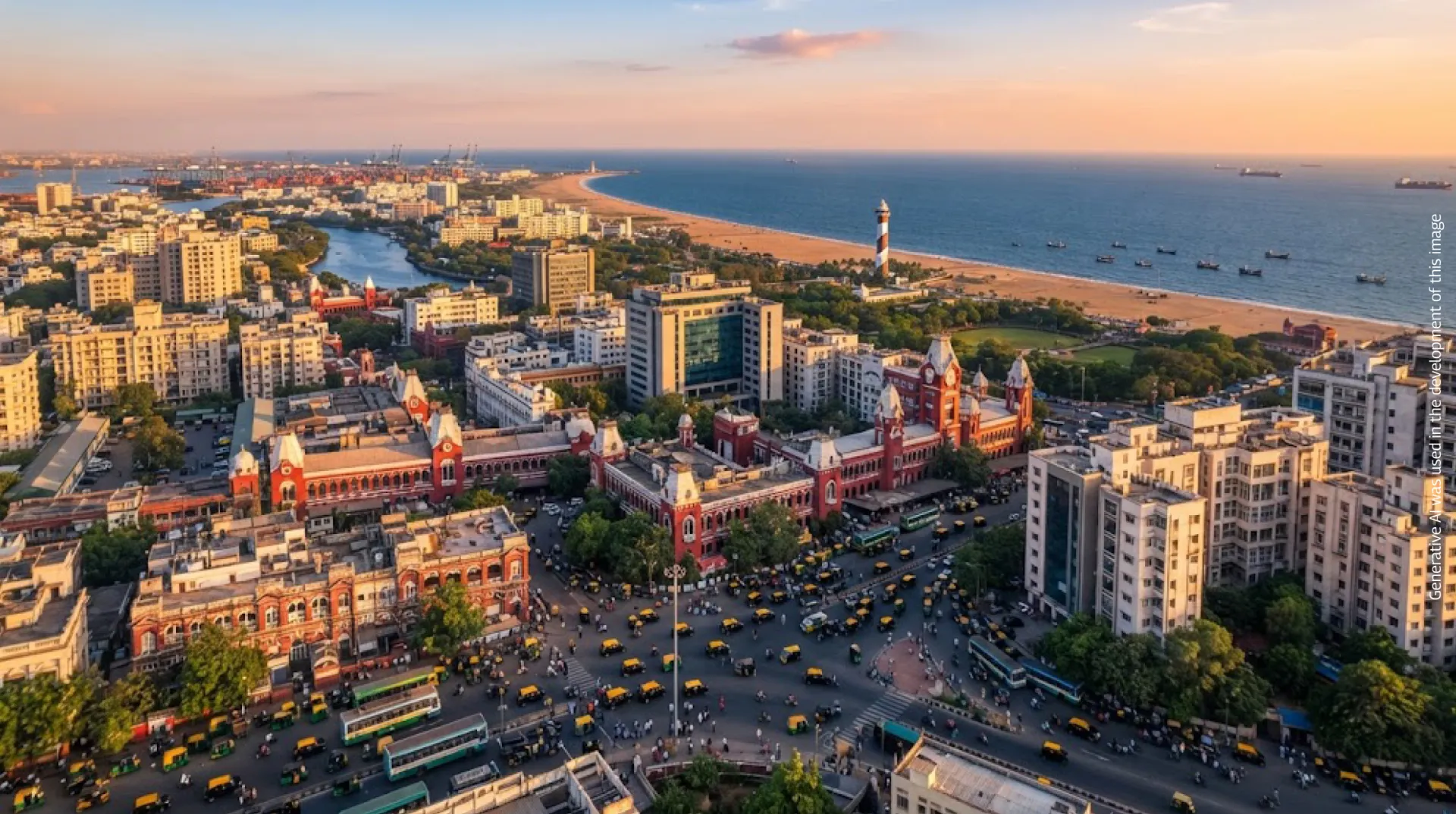
Chennai, the capital of Tamil Nadu, has evolved from a historic coastal city into one of India's most significant economic and industrial centres. Known for its thriving automobile manufacturing sector, IT corridors, educational institutions, and cultural heritage, the city attracts professionals, businesses, and homebuyers from across the country.
One of the most common questions people ask is, "What is Chennai's actual area in square kilometres?" The answer depends on the administrative boundary being considered. While many people refer to the area governed by the Greater Chennai Corporation (GCC), urban planners also consider the much larger Chennai Metropolitan Area (CMA), which extends into neighbouring districts.
Understanding these geographical distinctions is useful for anyone planning to relocate, purchase property, invest in real estate, or simply gain a better understanding of Chennai's urban development.
In this guide, we'll explain Chennai's area, city limits, major zones, metropolitan boundaries, and how the city's continued expansion is creating new opportunities for residents and investors.
When searching for "Chennai area in sq km," it's important to understand that different government authorities define Chennai using different administrative boundaries.
The table below explains these distinctions.
| Region | Approximate Area |
|---|---|
| Chennai District | 426 sq km |
| Greater Chennai Corporation (GCC) | 426 sq km |
| Chennai Metropolitan Area (CMA) | Around 5,900+ sq km |
For most residents, Chennai refers to the area administered by the Greater Chennai Corporation, which covers approximately 426 square kilometres.
However, the city's influence extends far beyond these municipal limits through the Chennai Metropolitan Area, which includes rapidly growing suburban and peri-urban regions.
Like many large metropolitan cities, Chennai is governed through multiple administrative and planning authorities.
Understanding these divisions helps explain why different sources report different land areas.
Chennai District
Chennai District represents the city's primary administrative district and covers much of the urban area governed by the Greater Chennai Corporation.
It serves as an important administrative unit for governance, public services, elections, and district-level planning.
Greater Chennai Corporation (GCC)
The Greater Chennai Corporation (GCC) is one of India's oldest municipal corporations and is responsible for administering Chennai city.
Its responsibilities include:
Most residential and commercial neighbourhoods commonly associated with Chennai fall within GCC limits.
Chennai Metropolitan Area (CMA)
The Chennai Metropolitan Area (CMA) is significantly larger than the municipal corporation.
Planned by the Chennai Metropolitan Development Authority (CMDA), the CMA includes Chennai city along with several surrounding municipalities, town panchayats, and villages spread across neighbouring districts.
The metropolitan area continues to expand as infrastructure projects improve connectivity and encourage new residential and commercial developments.
One reason many people become confused while researching Chennai's geography is that the term "Chennai land area" may refer to different administrative regions.
For example:
Each serves a different purpose in governance, infrastructure planning, and urban development.
Understanding these distinctions is particularly useful for homebuyers and investors evaluating emerging residential corridors beyond Chennai's traditional city limits.
Whether you're moving to Chennai for work, purchasing your first home, or investing in real estate, understanding the city's geographical structure can help you make informed decisions.
Knowing the difference between Greater Chennai Corporation limits, Chennai District, and the Chennai Metropolitan Area allows homebuyers to evaluate:
As Chennai continues to expand beyond its traditional city boundaries, several suburban locations are emerging as attractive destinations for homebuyers seeking better connectivity, lifestyle amenities, and future growth.
Chennai is broadly divided into several geographical zones, each with distinct residential, commercial, and industrial characteristics.
North Chennai
North Chennai is one of the city's oldest industrial regions and plays a vital role in logistics, shipping, and manufacturing.
Major localities include:
The region benefits from its proximity to Chennai Port, industrial estates, and freight infrastructure.
Central Chennai
Central Chennai serves as the city's commercial, administrative, and cultural hub.
Prominent localities include:
The area is home to government offices, educational institutions, shopping districts, and heritage landmarks.
South Chennai
South Chennai has witnessed significant residential and commercial growth over the past two decades.
Popular localities include:
The presence of IT parks, educational institutions, healthcare facilities, and improved road connectivity has made South Chennai one of the city's most sought-after residential regions.
West Chennai
West Chennai has emerged as an important residential and industrial corridor.
Key areas include:
These locations offer strong connectivity through arterial roads, metro connectivity, and industrial employment centres.
Chennai has grown well beyond its traditional municipal boundaries over the past two decades. While the Greater Chennai Corporation (GCC) governs the city's core urban area, rapid residential and commercial development has expanded into neighbouring districts such as Chengalpattu, Kancheepuram, and Tiruvallur.
This growth has been driven by a combination of industrial expansion, IT investments, improved road networks, metro rail development, and increasing demand for quality housing. As land availability within the city has become limited, emerging suburban corridors have transformed into thriving residential destinations.
Today, the Chennai Metropolitan Area (CMA) functions as an integrated urban region where people live in suburban locations while commuting to employment hubs across the city. This planned expansion has helped distribute economic activity while creating new opportunities for infrastructure development and real estate investment.
| Feature | Greater Chennai Corporation | Chennai District | Chennai Metropolitan Area |
|---|---|---|---|
| Purpose | Municipal Administration | District Administration | Metropolitan Planning |
| Approximate Area | 426 sq km | 426 sq km | 5,900+ sq km |
| Governing Authority | Greater Chennai Corporation | District Administration | CMDA |
| Includes Core Chennai | ✔ | ✔ | ✔ |
| Includes Expanding Suburban Areas | Limited | Limited | ✔ |
Understanding these administrative boundaries helps residents, businesses, and investors better interpret infrastructure projects, government announcements, and real estate trends.
Infrastructure continues to play a vital role in Chennai's transformation into one of South India's most important metropolitan cities. Several ongoing and planned projects are improving connectivity while supporting future residential and commercial development.
Chennai Metro Rail Expansion
The Chennai Metro Rail network has significantly improved connectivity between residential neighbourhoods, business districts, educational institutions, and commercial centres.
Upcoming metro corridors are expected to extend connectivity to additional suburban areas, making commuting more convenient and encouraging residential development along these routes.
Chennai Peripheral Ring Road (CPRR)
The Chennai Peripheral Ring Road is designed to improve regional connectivity by linking major national highways surrounding the city.
The project is expected to reduce traffic congestion while improving access to industrial corridors, logistics parks, and emerging residential locations.
Chennai-Bengaluru Expressway
The upcoming Chennai-Bengaluru Expressway is expected to reduce travel time between two of India's largest economic centres.
The improved connectivity will support industrial growth, logistics, and investment opportunities across the region.
IT Corridor Along Old Mahabalipuram Road (OMR)
Often referred to as Chennai's IT Corridor, Old Mahabalipuram Road has become home to numerous technology companies, Global Capability Centres (GCCs), and business parks.
Areas such as Sholinganallur, Perungudi, and Siruseri continue to attract professionals seeking homes close to employment centres.
Chennai Port and Ennore Port
As one of India's leading port cities, Chennai benefits from strong maritime infrastructure. Chennai Port and Kamarajar (Ennore) Port support manufacturing, exports, logistics, and international trade, contributing significantly to the city's economy.
Chennai remains one of India's most preferred residential destinations due to its balanced combination of employment opportunities, infrastructure, affordability, and quality of life.
Strong Employment Ecosystem
Chennai has established itself as a leading centre for:
The city's diversified economy continues to generate stable residential demand.
Excellent Educational Institutions
Chennai is home to some of India's most respected educational institutions, including:
These institutions attract students from across India and abroad.
Advanced Healthcare Infrastructure
Residents have access to world-class healthcare through hospitals such as:
This strong healthcare ecosystem contributes significantly to Chennai's quality of life.
Balanced Lifestyle
From beaches and cultural landmarks to shopping malls and entertainment hubs, Chennai offers a well-rounded urban lifestyle.
Popular destinations include:
These attractions enhance the city's appeal for families and working professionals.
Chennai is one of the largest and most economically significant cities in South India, alongside Bengaluru, Hyderabad, Kochi, Coimbatore, Mysuru, and Visakhapatnam.
The city stands out for its:
Its strategic location on India's eastern coast also makes Chennai an important gateway for international trade and logistics.
One of the reasons Chengalpattu has become a preferred residential destination is its excellent regional connectivity.
The distance from Chengalpattu to Puducherry (Pondicherry) is approximately 80–85 kilometres, depending on the route taken. The journey typically takes around 1.5 to 2 hours via the East Coast Road (ECR) or NH32, making Pondicherry a popular weekend getaway for residents of Chengalpattu and southern Chennai.
Improved highway connectivity has also strengthened the appeal of residential developments in this corridor, offering easy access to both Chennai and the scenic coastal destinations of Tamil Nadu.
As Chennai expands beyond its traditional city limits, homebuyers are increasingly looking for well-planned communities that offer excellent connectivity, modern amenities, and long-term growth potential.
Mahindra Lifespaces has developed premium residential projects in strategic locations that align with Chennai's evolving urban landscape.
Mahindra Aqualily at Mahindra World City
Located within Mahindra World City near Chengalpattu, Mahindra Aqualily offers thoughtfully designed homes in one of South India's largest integrated business cities.
Residents benefit from proximity to employment hubs, educational institutions, healthcare facilities, and excellent road and rail connectivity. The township also offers green open spaces and a well-planned community environment, making it an attractive option for families and professionals.
Mahindra Lakewoods, Chengalpattu
Mahindra Lakewoods offers modern residences in Chengalpattu, a rapidly developing micro-market that is gaining attention due to its improving infrastructure and strategic location.
With convenient access to GST Road, industrial corridors, educational institutions, and business hubs, the project provides residents with a balanced lifestyle while benefiting from the region's long-term growth potential.
Chennai's growth extends far beyond its traditional city limits. While the Greater Chennai Corporation governs the city's core area of approximately 426 sq km, the much larger Chennai Metropolitan Area reflects the city's ongoing expansion into neighbouring districts and emerging growth corridors.
Supported by metro rail expansion, highway projects, industrial development, and world-class social infrastructure, Chennai continues to attract professionals, families, and investors seeking a well-connected and future-ready city. Locations such as Chengalpattu and the southern growth corridor demonstrate how infrastructure investment is creating new residential opportunities beyond the city's traditional boundaries.
For homebuyers looking to benefit from this transformation, Mahindra Lifespaces offers thoughtfully planned communities such as Mahindra Aqualily and Mahindra Lakewoods, combining strategic locations, modern amenities, and sustainable living. As Chennai continues to evolve, understanding its administrative boundaries and growth zones can help homebuyers make more informed property decisions.
Disclaimer: This content is for educational and informational purposes only and does not constitute financial, legal, or professional advice. Please consult with a certified professional or legal counsel before making any decisions based on this information.
The Greater Chennai Corporation (GCC) covers approximately 426 square kilometres, while the Chennai Metropolitan Area spans over 5,900 square kilometres.
The GCC administers Chennai city, whereas the CMA is a larger planning region managed by the Chennai Metropolitan Development Authority (CMDA) and includes several neighbouring urban and suburban areas.
Southern and southwestern corridors, including Sholinganallur, Siruseri, Medavakkam, Tambaram, and Chengalpattu, have witnessed significant residential and infrastructure growth in recent years.
Chengalpattu benefits from improving road and rail connectivity, proximity to Mahindra World City, industrial growth, educational institutions, and comparatively larger residential developments, making it an attractive destination for long-term investment.
The distance between Chengalpattu and Pondicherry is approximately 80–85 km, and the drive usually takes around 1.5 to 2 hours, depending on traffic and the chosen route.
Chennai is a major centre for manufacturing, IT services, healthcare, education, logistics, and international trade. Its strong economy, coastal location, and infrastructure make it one of the leading metropolitan cities in South India.

Established in 1994, Mahindra Lifespace Developers Ltd. (‘Mahindra Lifespaces’) brings the Mahindra Group’s philosophy of ‘Rise’ to India’s real estate and infrastructure industry through thriving residential communities and enabling business ecosystems.


