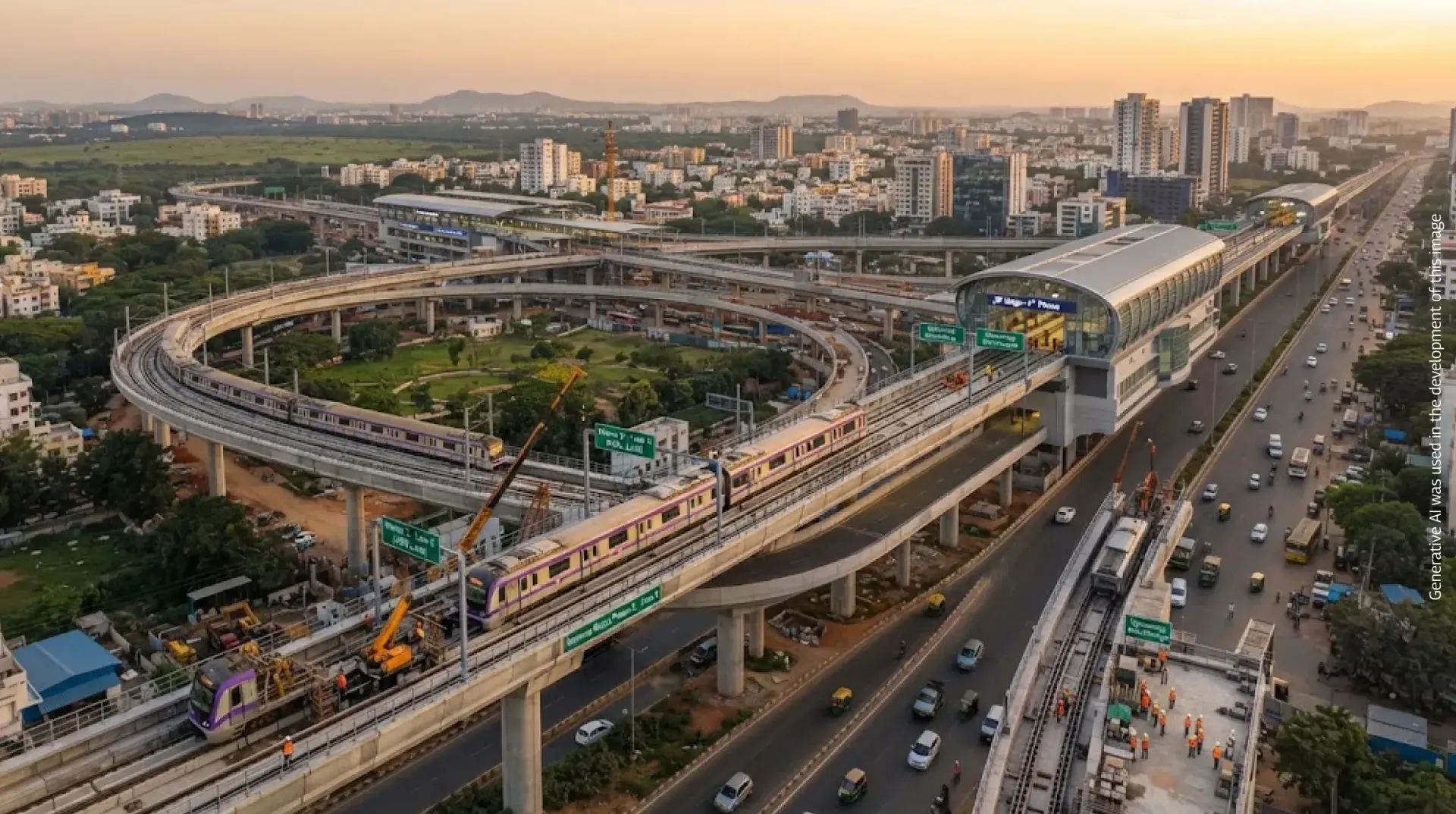
Bengaluru's rapid growth has brought with it a familiar challenge: longer commutes. For many residents, travelling between key employment hubs and residential neighbourhoods can take well over an hour during peak traffic. This is where Bangalore Metro Phase 3 is expected to play a transformative role.
The next stage of the city's metro expansion is designed to improve connectivity across several high-growth corridors, including Hebbal, Sarjapur, JP Nagar, Hosahalli and Kadabagere. Beyond reducing travel times, the project is also expected to influence residential demand, infrastructure development and long-term urban growth.
In this guide, we break down the proposed routes, expected benefits, future corridors, and what Namma Metro Phase 3 could mean for homebuyers, investors and daily commuters.
Bangalore Metro Phase 3 is one of the most significant planned expansions of Bengaluru's metro network. The project aims to strengthen east-west and north-south connectivity while improving access to employment hubs, residential districts and future growth corridors.
The approved Phase 3 network includes two key corridors spanning approximately 44.65 km and 31 stations. Alongside this, the proposed Sarjapur to Hebbal corridor, often referred to as Namma Metro Phase 3A, is expected to become one of Bengaluru's most important future transit links.
According to the official plans published by Bangalore Metro Rail Corporation Limited (BMRCL), the objective is to create a more integrated urban transport network that reduces road congestion and supports sustainable growth.
Orange Line: JP Nagar 4th Phase to Kempapura
This corridor is expected to connect southern Bengaluru with northern parts of the city.
Key highlights:
The corridor is expected to improve accessibility between established residential neighbourhoods and major employment zones.
Grey Line: Hosahalli to Kadabagere
The Grey Line focuses on improving connectivity in western Bengaluru.
Key highlights:
While this corridor receives less attention than the Orange Line, it could unlock development opportunities in areas that currently depend heavily on road transport.
Among all proposed future transit links, the 36.59 km Sarjapur to Hebbal corridor (Phase 3A / Red Line) is one of the most anticipated routes in Bengaluru.
This alignment is important because it connects some of Bengaluru's largest residential and employment clusters. Today, commuters travelling between Sarjapur and Hebbal often spend 90 to 120 minutes during peak hours. A metro connection could significantly improve travel efficiency and reduce dependence on private vehicles.
Unlike many previous metro extensions, this corridor directly addresses connectivity challenges between major residential districts and technology hubs.
Metro projects are not just transportation initiatives. They influence where people choose to live, work and invest. Some of the future growth corridors likely to benefit include:
Hebbal
Hebbal has evolved into one of North Bengaluru's most important infrastructure and employment hubs. Positioned as North Bengaluru's premier transit and commercial hub, Hebbal benefits from multi-modal integration—connecting Airport Metro (Blue Line), ORR (Orange Line), and the central Red Line.
Key advantages:
Sarjapur
Sarjapur continues to attract professionals working across Bengaluru's technology ecosystem.
Growth drivers include:
Hosur Road
Enhanced interchange connectivity via the Yellow Line and Phase 3 networks further elevates Hosur Road's positioning as an accessible residential and employment corridor.
The area already benefits from:
Kadabagere
Kadabagere could emerge as a growth corridor for homebuyers looking at long-term appreciation potential. As the Grey Line extends westward, once-peripheral markets like Kadabagere offer attractive entry prices and high appreciation potential for strategic homebuyers.
Bangalore Metro Phase 3 has moved from the planning board to active execution, marking one of the most critical infrastructure milestones in Bengaluru's modern urban expansion.
By securing full central government backing and funding, Bangalore Metro Rail Corporation Limited (BMRCL) is progressing according to schedule to deliver a high-capacity, future-ready transit network that promises to decongest key arterial routes like the Outer Ring Road (ORR-West) and Magadi Road.
Infrastructure projects pass through distinct value-appreciation phases. With Phase 3 now firmly in the civil procurement and groundwork phase, peripheral locations along the Orange and Grey Lines—such as Hebbal, Peenya, Nagarabhavi, and Kadabagere—are experiencing heightened interest from developers and end-users looking to capitalise on future multi-modal transit access.
As metro infrastructure expands across Bengaluru, connectivity is becoming a key factor in residential decision-making.
For homebuyers exploring well-connected neighbourhoods, Mahindra Lifespaces offers residential developments in strategically located growth corridors.
Projects such as Mahindra Blossom in Whitefield and Mahindra NewHaven off Hosur Road are situated within established residential markets that benefit from strong employment connectivity and ongoing infrastructure improvements. As Bengaluru's transport network continues to evolve, access to major roadways, business districts and public transit systems remains an important consideration for long-term homeowners.
Disclaimer: This article is intended for informational purposes only and should not be considered legal, financial, investment, real estate, or professional advice. Information related to Bangalore Metro Phase 3, proposed corridors, approvals, station locations, project timelines, connectivity plans, and potential real estate impact may change as the project progresses. Readers are advised to verify the latest information through BMRCL, government authorities, and other official sources before making any travel, property purchase, or investment related decision.
The Sarjapur to Hebbal corridor is proposed under the future Namma Metro Phase 3A expansion and is expected to significantly improve connectivity between East and North Bengaluru.
Phase 3 consists of two elevated corridors totalling 44.65 km and 31 stations: the Orange Line (JP Nagar 4th Phase to Kempapura) and the Grey Line (Hosahalli to Kadabagere).
Metro connectivity can improve accessibility and increase demand for residential properties. However, property appreciation depends on several factors including location, infrastructure development and market conditions.
Sarjapur is one of Bengaluru's fastest-growing residential and technology corridors. Metro connectivity could reduce travel times and improve access to other parts of the city.
Hebbal, Sarjapur, JP Nagar, Hosur Road, Hosahalli and Kadabagere are among the areas expected to benefit from improved connectivity.
The primary Phase 3 corridors have received approval, while certain future extensions and corridor proposals continue to progress through planning and evaluation stages. The Union Cabinet approved Bangalore Metro Phase 3 on August 16, 2024, with an estimated cost of ₹15,611 crore.

Established in 1994, Mahindra Lifespace Developers Ltd. (‘Mahindra Lifespaces’) brings the Mahindra Group’s philosophy of ‘Rise’ to India’s real estate and infrastructure industry through thriving residential communities and enabling business ecosystems.


Things to Do in Alibaug: The Ultimate Guide to Beaches, Forts & Food

Alibaug Connectivity Guide: How Atal Setu (MTHL) Transforms Real Estate