


Popular searches





Real Estate Trends in Whitefield: Price Appreciation Over the Last Decade
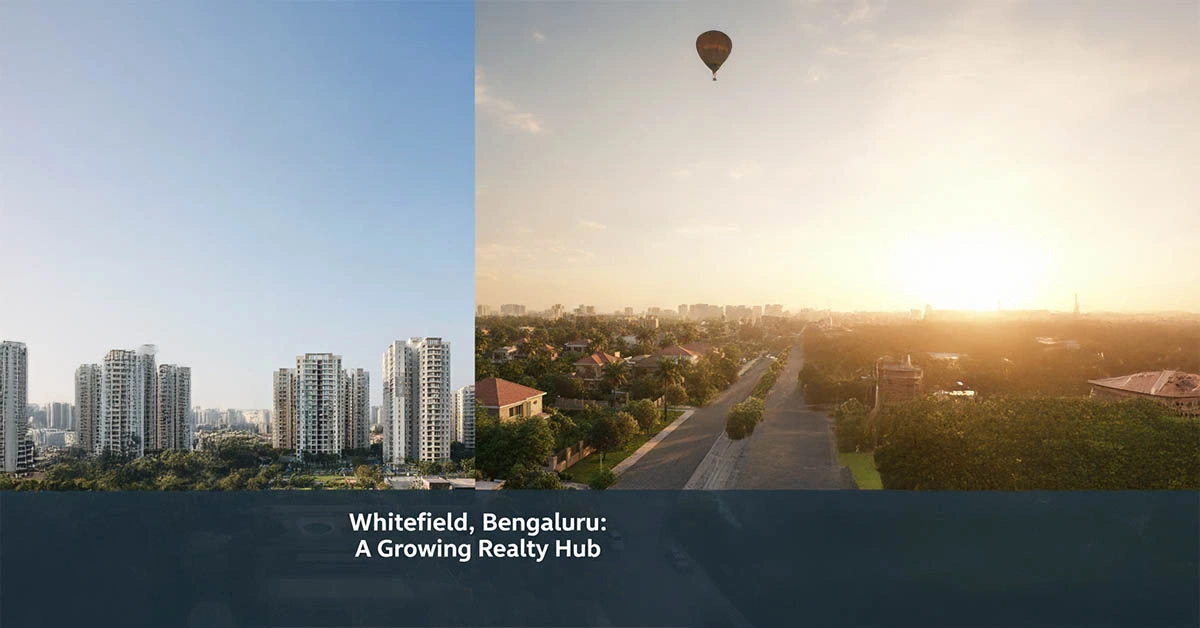
Whitefield in East Bengaluru has long evolved from a quiet suburb into one of the city’s
foremost real estate hotspots. Home to large tech parks (like ITPL), good schools, and
improving connectivity; it draws both homebuyers and investors.
Understanding price trends over the last decade is crucial—for potential homebuyers,
investors, developers, or anyone looking to gauge where the market is headed. It helps
in planning, negotiating, and deciding when & where to enter.
Historical Overview: The Growth Story of Whitefield
Whitefield’s transformation over the years has been nothing short of remarkable.
According to The Indian Express, Whitefield was originally a quiet settlement for Anglo-
Indian communities until the early 2000s, when the IT boom triggered its transformation
into Bengaluru’s eastern growth corridor.
Here’s a quick look at the major milestones that shaped its growth:
- Pre-2000s – A Quiet Cantonment Outpost
Originally established as an Anglo-Indian settlement in the late 1800s, Whitefield
remained a serene village on Bengaluru’s periphery for much of the 20th century. It was
known more for its open spaces and farmlands than for urban development.
- Early 2000s – IT Boom and Birth of ITPL
The establishment of the International Tech Park Bangalore (ITPB), one of the city’s
first major tech parks, marked a turning point. Global IT companies began setting up
offices here, creating new employment opportunities and sparking interest in residential
projects nearby.
- 2010–2015 – Residential and Infrastructure Growth
During the early 2010s, Whitefield was still viewed as a suburban stretch with moderate
infrastructure and limited road connectivity. However, with the rise of IT/ITES firms in
ITPL and EPIP Zone, the area saw a surge in housing demand. Prominent developers
launched large-scale apartment complexes and townships, while new roads,
flyovers, and public facilities began taking shape.
- 2015–2020 – Emergence as a Self-Sufficient Urban Hub
By the mid-2010s, Whitefield was no longer just an employment zone—it had become a
complete lifestyle destination. The opening of major malls (like Phoenix Marketcity
and Forum Shantiniketan), reputed schools, hospitals, and entertainment hubs
turned it into a self-sustained ecosystem. Commercial real estate, co-working spaces,
and premium residential projects flourished during this period.
- 2020–Present – Metro Expansion and Connectivity Revolution
The extension of the Namma Metro Purple Line to Whitefield marked a major milestone in improving connectivity. With the Whitefield (Kadugodi) Metro Station
serving as the eastern terminal, commuting to the city centre has become far more
convenient. Ongoing infrastructure upgrades and improved civic amenities continue to
enhance the overall quality of life in the region.
- Today: A Modern, Connected Neighbourhood
From a once-quiet settlement to a buzzing urban corridor, Whitefield today stands as
one of Bengaluru’s most desirable residential and business destinations—a
perfect blend of connectivity, convenience, and community living.
Infrastructure Growth
A few infrastructure developments had outsized impact on property prices:
- IT Parks: The establishment and expansion of ITPL / International Tech Park
Bangalore, EPIP Zone etc. created employment hubs, driving demand. - Metro Connectivity: As metro lines expanded (notably the Namma Metro Purple
Line reaching Kadugodi / Whitefield), connectivity improved, reducing commute
times and increasing demand for homes nearer to metro stations. - Schools and Hospitals: High quality institutions (e.g. Vydehi Institute, Ryan
International, and others), along with good hospitals like Sri Satya Sai Hospital,
have made Whitefield attractive to families. Retail and entertainment too (malls,
outlets) improved lifestyle appeal.
Price Appreciation Analysis
Whitefield’s Steady Price Growth Over the Decade
Over the past decade, property values in Whitefield have shown consistent
appreciation, supported by continuous infrastructure development, strong employment
growth from the IT corridor, and the connectivity boost brought by the Namma Metro
expansion.
According to leading real estate research platforms such as MagicBricks, 99acres, and
Knight Frank India, Whitefield remains one of Bengaluru’s most robust micro-
markets, showing steady value growth across both mid-segment and premium housing
categories.
What began as a moderately priced suburban zone in the early 2010s has evolved into
a prime residential destination — with prices in most established neighborhoods having
nearly doubled over the past ten years.
Premium pockets near tech parks, business districts, and metro stations have
performed especially well, reflecting sustained buyer demand and investor
confidence. Analysts note that Whitefield’s long-term appreciation has generally
remained in the high single to low double digits annually, underscoring its position
as a stable and future-ready investment hub in East Bengaluru.
Sources: Knight Frank India Residential Market Reports, MagicBricks PropIndex,
99acres Research Insights.
Factors Behind Appreciation
Multiple interlinked factors have driven the price escalation:
- Economic Growth & IT Demand: As the number of tech/IT/outsourcing
companies like Google and Infosys, around Whitefield and East Bangalore has
grown, so has high-income employment, leading to stronger purchasing power. - Supply–Demand Dynamics: Land is limited to prime micro-locations; high
demand from end users (professionals, families) keeps prices up. Also, many
developers target premium segments, pushing the upper end. - Infrastructure Development: Better road connectivity (Outer Ring Road,
Varthur Road improvements), metro connectivity, better schools, hospitals and
commercial centres increase value. - Lifestyle & Amenities: Modern apartments with amenities, gated communities,
retail and entertainment options have become standard expectations. Buyers are
willing to pay more for a better quality of life. - Policy and Financing: Loan interest rates, regulatory ease, real estate policy,
approvals, etc., contribute. Though these have mixed impact, favorable policies
or lower financing costs help fuel demand.
Comparison with Other Areas
Price Trends in Similar Localities
Here are how some other well-known localities have fared or are priced, for comparison:
| Locality | Average Price (2024-25) ₹/sqft* | Key Characteristics / Growth Drivers |
|---|---|---|
| Koramangala | ~ ₹10,000-₹15,000 or above for mid-premium apartments (purvaaerocity.gen.in) | Central, mature infrastructure, premium lifestyle, high demand. |
| Indiranagar | ~ ₹12,000-₹18,000+ in many parts. (purvaaerocity.gen.in) | Very high lifestyle premium, proximity to central business districts, established posh area. |
| Electronic City | ~ ₹4,500-₹7,000 in many residential pockets in 2024. (purvaaerocity.gen.in) | Strong IT presence, usually less premium than East/Bengaluru East in terms of connectivity to north/south etc. |
* = Based on listings and published aggregation sources; actual depends on micro-location, builder, amenities.
Why Whitefield Stands Out
While many areas have seen price appreciation, Whitefield has several advantages that
make its growth distinctive:
- Connectivity improvements (metro, roads) are now more mature. Areas
closer to metro stations are premium. - Balance of amenities + employment: Not just residential, but employment
hubs nearby reduce long-haul commuting. - Variety of options: From budget / mid-segment to premium / luxury, gated
communities, etc. So, it captures a broader segment. - Lifestyle & infrastructure: Schools, hospitals, retail, parks are good and
getting better. For many buyers this holistic package matters, not just price.
These factors mean that Whitefield often gives comparatively good returns relative to
what one pays (especially compared to more premium central localities) albeit with
trade-offs (distance from the city centre, traffic, etc.).
Future Forecast
Upcoming Projects
- Metro Expansions: More metro connectivity (Purple Line extension, stations
within Whitefield, etc.) will make access better and likely raise premium for
flats closer to planned/operational stations.
The Purple Line extension and improved last-mile links will make daily
commutes even smoother, significantly increasing the appeal and property value
of homes located near operational and upcoming metro stations.
Adding to this transformation is the Blue Line (Airport Line) — a major
infrastructure boost that will connect Kempegowda International Airport (KIA)
to the city through KR Puram. Once fully operational, commuters traveling from
Whitefield to the airport can simply take the Purple Line up to KR Puram and
switch to the Blue Line, reaching the airport comfortably in under an hour
- New Residential / Mixed Use Projects: Developers continue to launch
premium projects, luxury apartments, gated communities, etc. Also,
commercial & retail developments in and around Whitefield will add value. - Road & Other Infrastructure Upgrades: Improved roads, flyovers, bridging
traffic bottlenecks, better water / sewage / services – all will aid livability and
thus price appreciation.
Expert Predictions
- Many real estate analysts project 5-10% annual appreciation for Whitefield (for standard residential properties) in the next few years, with higher growth (10-15%+) in premium micro-locations.
- Rental appreciation in Whitefield and its outskirts has already been strong (20-25% over the past 1-2 years in some areas) and is expected to continue,
particularly for 2 & 3 BHKs.
Investment Advice
Best Practices for Real Estate Investment in Whitefield
- Locate near infrastructure: Metro stations, major roads, schools, hospitals.
Proximity tends to give premium and better appreciation. - Check builder reputation & project stage: Pre-launch prices are lower but
riskier; finished / ready or near-possession often cost more but give more
certainty. - Amenities & quality: Buyers often pay for amenities; ensure what is offered is
real (maintenance, quality). - Understand hidden costs: Registration, parking, maintenance, common
charges, property tax etc. These can add significantly. - Evaluate rental yield: Focus on calculating the Net Rental Yield to understand
your true, immediate income potential. Whitefield, being a major IT hub, has a
strong and stable rental market, often yielding above the Bangalore average
(generally in the 4% to 6% range for apartments). In Whitefield, 2 BHK and 3
BHK units are generally in the highest demand from IT professionals and small
families, often leading to better occupancy rates and higher yields in projects
close to the ITPL/EPIP zones. - Evaluate capital appreciation: While the rental market is stable, your long-term
wealth will come from Capital Appreciation. Whitefield has shown significant
historical growth, and future growth depends on the completion of major
infrastructure projects. Properties within a 1-2 km radius of metro stations (like
Kadugodi, Whitefield, Hoodi) tend to see above-average price jumps, especially
once connectivity is established.
Property Investment Opportunities in Whitefield
- Premium micro-locations: Flats near metro, malls, major roads likely to
outperform. - Mixed use / gated / luxury projects: If you can identify ones with good
reputations and proper delivery. - Long-term holding: Over 5-10 years, Whitefield is likely to see positive returns
due to the fundamentals. - Rental demand: Given the IT workforce, proximity to employment hubs, rental
demand remains strong; rental yields for 2-3 BHKs are attractive in many parts.
Over the last decade, Whitefield has seen strong and relatively steady price
appreciation—from around 8 to 10% (and more in premium pockets) by 2024-2025. Key
drivers are infrastructure, connectivity, employment growth, and lifestyle amenities.
While Whitefield may not match central localities in terms of absolute price, its balance
of value, appreciation potential, and quality makes it one of the strongest investment-
grade areas in Bengaluru.
If you're considering investing in Whitefield, focus on the exact location you want,
reputation of the builder, nearby infrastructure, hidden and overarching costs, and align
your investment horizon (5-10 years tends to make sense).