


Popular searches





Stamp Duty Tax Exemption for First-Time Homebuyers in India

Buying a home is a milestone in life, but did you know that homebuyers could save lakhs in taxes with stamp duty tax exemptions? For many first-time homebuyers, the joy of owning a home often comes with complex financial planning. While the down payment and EMIs are top of mind, stamp duty tax remains a significant yet sometimes overlooked cost.
Thankfully, several government provisions, and stamp duty and registration tax exemptions like Section 80C, offer meaningful relief. At Mahindra Lifespaces, we help first-time homebuyers navigate these cost-saving opportunities with clarity and confidence.
What is Stamp Duty Tax and Why is it Important?
Buying a home involves several costs, and stamp duty tax is one of the most significant.
Stamp duty tax is a legal charge levied by the respective state governments during property registration. It applies to both under-construction and ready-to-move-in homes. The rate typically ranges from 4% to 7% of the property value and is mandatory for validating ownership. For first-time homebuyers, this cost can be significant.
For example, for a property valued at ₹50 lakh in Maharashtra with a 5% stamp duty tax rate, the buyer pays ₹2.5 lakh just in stamp duty tax. Overlooking this during budgeting can lead to financial strain, making it vital to plan.
Stamp Duty and Registration Tax Exemption for First-time Homebuyers
Many state governments offer stamp duty and registration tax exemptions for first-time homebuyers to encourage affordable housing and increase homeownership. These include:
- Maharashtra: 1% rebate for women homebuyers.
- Delhi: Subsidies under affordable housing for first-time homebuyers.
- Tamil Nadu and Karnataka: Lower duties for homes under government schemes.
- Jaipur: Reduced duty for first-time homebuyers purchasing homes below certain thresholds.
These stamp duty tax exemptions support inclusive housing and empower diverse homebuyer segments like women, senior citizens, and LIG/EWS categories.
Eligibility Criteria for Exemption
To qualify for these benefits:
- The homebuyer must be purchasing a residential property for the first time.
- They must not own any other home in India.
- Some concessions apply only if the property is registered within a specified time frame.
- Certain states link eligibility to property value or carpet area (e.g., homes under ₹50 lakh).
Is Stamp Duty Tax Deductible Under Section 80C?
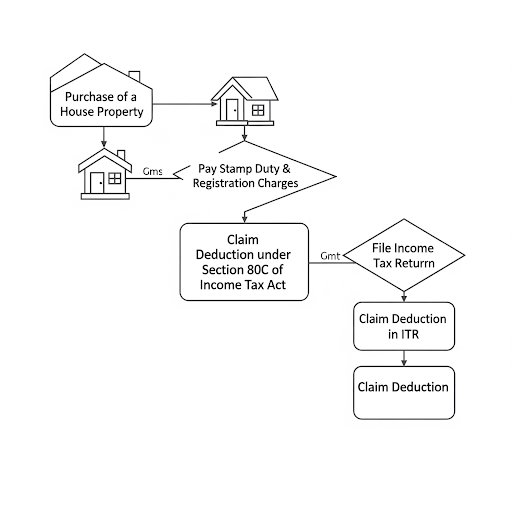
First-time homebuyers can claim a deduction of up to ₹1.5 lakh under Section 80C for stamp duty and registration tax exemption, but only in the financial year in which the payment is made.
For instance, suppose you purchase a house and pay ₹1.2 lakh as stamp duty and ₹30,000 as registration charges during the current financial year. You can claim a deduction of ₹1.5 lakh under Section 80C, which will reduce your taxable income by that amount for the year.
These deductions can be claimed based on the following factors:
- Individual taxpayers or HUFs (Hindu Undivided Families).
- The property must be for self-use or self-occupation.
- Not valid for investment properties or resale homes.
- Cannot be claimed by co-owners who are non-taxpaying dependents.
| State | Stamp Duty and Registration Rate |
|---|---|
| Maharashtra |
– Urban Areas: 6% (men) / 5% (women) – Gram Panchayats: 3% (men) / 2% (women) – MMRDA Zones: 4% (men) / 3% (women) (includes Panchayats, Municipal Councils & Cantonments) – Women buyers save 1% stamp duty across all locations |
| Karnataka |
Above ₹45 Lakh: – Stamp Duty: 5% – Registration: 1% ₹20-45 Lakh: – Stamp Duty: 3% – Registration: 1% Below ₹20 Lakh: – Stamp Duty: 2% – Registration: 1% |
| Tamil Nadu |
Standard Rates: – Stamp Duty: 7% (all buyers) – Registration Fee: 4% (all buyers) Special Concession (Effective 1 April 2025) – For women buyers purchasing properties ≤₹10 lakh: – Reduced stamp duty: 3% (instead of 7%) – Registration fee remains at 4% |
| Delhi NCR |
Female Owners: – Stamp Duty: 4% – Registration: 1% Male Owners: – Stamp Duty: 6% – Registration: 1% Joint Ownership (Male + Female): – Stamp Duty: 5% (averaged) – Registration: 1% |
| Rajasthan |
Men: – Stamp Duty: 6% – Registration Fee: 1% – Surcharge: 20% of stamp duty (₹1.20 per ₹100) Women: – Stamp Duty: 5% (1% discount) – Registration Fee: 1% – Surcharge: 20% of stamp duty (₹1 per ₹100) |
These state-level incentives offer tax exemption on stamp duty and registration, helping first-time homebuyers achieve ownership goals in high-potential cities like Mumbai, Pune, Chennai, Jaipur, and Bengaluru.
How Mahindra Lifespaces Helps First-time Buyers Save More
At Mahindra Lifespaces, we provide a comprehensive cost sheet detailing all charges, including stamp duty tax, registration, GST, and more, up front. This transparency helps homebuyers plan effectively while understanding how to maximise tax savings.
We also assist homebuyers with:
- Calculating stamp duty liabilities
- Documentation for Section 80C claims
- Clarifying state-level stamp duty tax exemptions
Many developments by Mahindra Lifespaces are designed to meet PMAY and state guidelines, qualifying homebuyers for tax exemption on stamp duty and registration. Our projects offer:
- Compact, well-planned homes below ₹50 lakh
- Sustainable designs aligned with our green building standards
- Locations near upcoming infrastructure like expressways and metro lines (e.g., Mumbai Trans Harbour Link, Bengaluru Metro Phase 2, Pune Ring Road)
How to Claim Stamp Duty Tax Exemption and Deductions?
Claiming tax exemption on stamp duty and registration involves proper documentation and timely filing.
Documents Required:
- Sale agreement
- PAN card and Aadhaar card
- Stamp duty tax receipt
- Form 16/salary slips (if salaried)
Ensure all documents are accurate and up to date to avoid delays or rejections. Tax deductions for stamp duty must be filed in the same assessment year the payment is made.
Include them in your ITR filing with proof of payment. For a hassle-free process, consult a qualified tax advisor or chartered accountant.
Key Points First-time Homebuyers Should Remember
Here are a few things to remember:
- Section 80C benefits cannot be carried forward to another financial year.
- The property and home loan must be in your name.
- Co-owners can claim proportional benefits if eligible.
- Verify eligibility for stamp duty and registration tax exemption before registration.
- Check alignment with PMAY or housing loan conditions to maximise benefits.
Note: Some Indian states offer additional rebates or stamp duty concessions for women homebuyers or first-time buyers. Check for state-specific benefits before proceeding with property registration.
Make Your First Home Count with Smart Tax Savings
Owning your first home is not just an emotional milestone; it’s a significant financial achievement. It can also be a financially rewarding journey.
At Mahindra Lifespaces, we go beyond just offering homes. Our commitment to sustainability, transparency, and homebuyer support ensures that your first home is not only affordable but also future-ready. Explore our well-connected and eco-friendly homes in your city now.
Ready to take the next step? Discover your dream home with Mahindra Lifespaces today.
FAQs
1. Can I claim both stamp duty tax exemption and Section 80C deduction?
Yes, as a first-time homebuyer, you can claim both the stamp duty tax exemption (if applicable in your state) and the Section 80C deduction for homebuyers on the amount paid towards stamp duty and registration charges, provided all eligibility conditions are met.
2. Is the exemption available on a second home?
No, stamp duty and registration tax exemption benefits are generally available only for first-time homebuyers purchasing their first residential property in India.
3. What if my spouse is the co-owner?
If your spouse is a co-owner and a first-time homebuyer, both of you may claim proportionate tax exemption on stamp duty and registration, subject to individual eligibility and tax compliance.
4. Can I claim tax benefits if the property is jointly owned by me and a non-working spouse?
Yes, you may claim the Section 80C deduction on your share of stamp duty and registration tax exemption if the payment has been made from your income and the property is co-owned.
5. Do I need to live in the home immediately to claim tax benefits?
No, immediate occupancy is not mandatory to claim Section 80C benefits for stamp duty and registration charges. However, the property must not be sold within five years of possession. If sold earlier, the claimed deductions may be reversed and added back to your taxable income in the year of sale.
6. Are tax benefits transferable if I sell the property later?
No, tax benefits under Section 80C are not transferable. If the property is sold within five years of possession, any tax benefits claimed will be reversed and taxed as income in the year of sale. Additionally, the new buyer cannot claim the previous owner’s deductions, as they can only claim applicable benefits based on their own eligibility and payment.
6. Are tax benefits transferable if I sell the property later?
No, tax benefits under Section 80C are not transferable. If the property is sold within five years of possession, any tax benefits claimed will be reversed and taxed as income in the year of sale. Additionally, the new buyer cannot claim the previous owner’s deductions, as they can only claim applicable benefits based on their own eligibility and payment.
7. What happens if the registration is delayed? Can I still claim deductions?
The Section 80C deduction for stamp duty and registration charges must be claimed in the same financial year the payment is made, so delayed registration may make you ineligible for that year’s deduction.