



Popular searches





Understanding GST in Real Estate: Applicability, Rates, and Implications
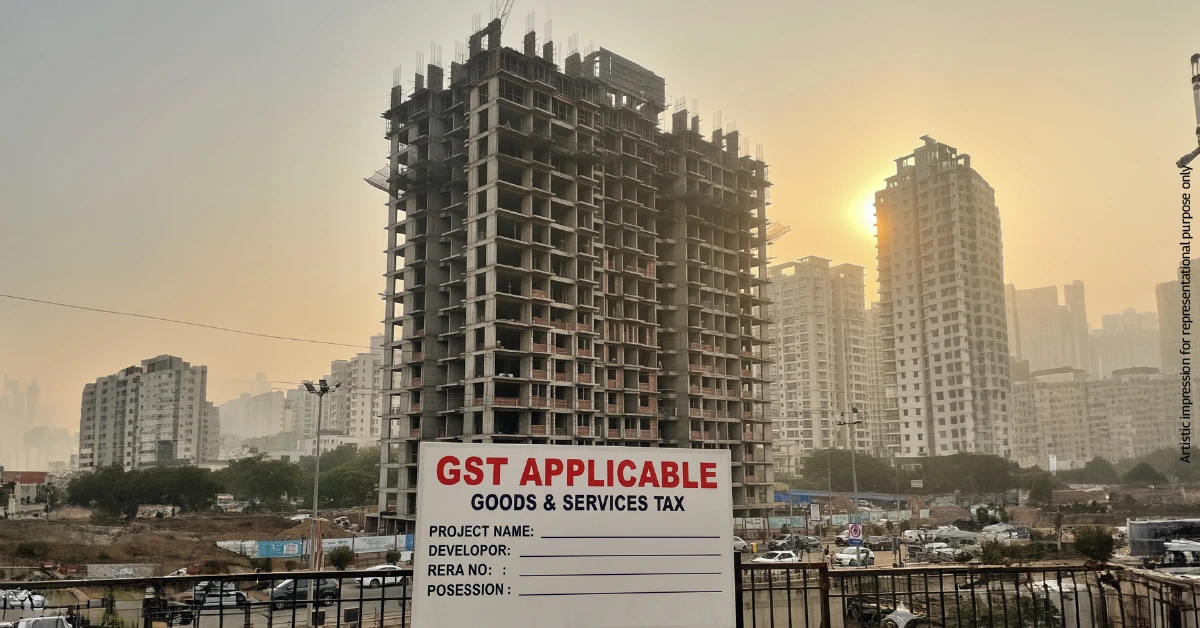
GST Rates on Under-Construction and OC-Received Properties: A Comprehensive Guide
The introduction of the Goods and Services Tax (GST) has significantly restructured India’s tax landscape, especially within the real estate sector. For both developers and property buyers, understanding how GST applies to under-construction and OC (Occupancy Certificate)-received properties is crucial.
GST in the real estate sector of India has helped home buyers, investors, and developers clearly understand how GST affects property purchase, sale, and construction costs.
In this blog, we’ll explain in detail the applicability, rates, and implications of GST on real estate transactions — covering both residential and commercial properties — to help you make better-informed property decisions.
What is GST (Goods and Services Tax) in Real Estate?
GST is a unified indirect tax imposed on the supply of goods and services, which includes certain real estate transactions. It was introduced to simplify the previously complicated tax structure that included multiple indirect taxes like VAT, service tax, and excise duty. By replacing these with a single tax framework, GST has made the taxation process more transparent and streamlined across India.
In the context of real estate, GST applies to transactions involving under-construction flats, residential apartments, and commercial properties, ensuring a uniform tax rate across the country. Explore our under-construction flats in Bangalore today.
Applicability of GST in Property Transactions
GST applies differently depending on whether a property is under construction or already completed.
- Applicable: Under-construction properties or those that have not yet received an Occupancy Certificate (OC).
- Not Applicable: Completed or resale properties that already have an OC.
This means GST is mainly relevant during the construction phase and not after the property is deemed complete by the concerned authority. Therefore, when buyers search for properties, it’s important to know whether the property is under construction or has an occupancy certificate, as GST applicability directly depends on this factor.
Difference in GST Applicability: Under-Construction vs OC-Received Properties
- Under-Construction Properties: GST is levied on the total sale consideration, excluding stamp duty and registration charges. This makes the tax applicable to the base property cost.
- OC-Received Properties: These are considered completed constructions and are therefore exempt from GST. Buyers of such properties only need to pay stamp duty and registration fees.
GST Applicability on Real Estate Transactions
1. Properties Subject to GST:
- Under-construction residential apartments awaiting OC.
- Under-construction commercial spaces, including shops and office units, awaiting OC.
2. Properties Exempt from GST:
- Completed properties that have received an Occupancy Certificate (OC) or Completion Certificate (CC) from the municipal or development authority.
- Resale properties (secondary market transactions) that already have an OC or CC.
GST Rates on Under-Construction Properties
The GST rate on an under-construction property depends on whether the project, as registered under RERA, qualifies as a Residential Real Estate Project (RREP) or a Real Estate Project (REP). Understanding the GST rate for under-construction properties in 2025 helps buyers estimate the total cost of ownership and plan their finances accordingly.
- RREP refers to a project where the carpet area of commercial apartments does not exceed 15% of the total carpet area of all apartments.
- If the commercial carpet area exceeds 15%, the project is categorized as REP.
1. Residential Properties
a. Affordable Housing in RREP or REP: GST Rate: 1% (without Input Tax Credit) — Developers are required to pay this amount in cash.
- Criteria for Affordable Housing:
- Carpet area up to 60 sq. meters in metro cities (Delhi NCR, Mumbai including MMR, Kolkata, Bengaluru, Hyderabad, Chennai).
- Carpet area up to 90 sq. meters in non-metro cities.
- The total property value, including parking, development, preferred location, and common facility charges, should not exceed ₹45 lakhs.
b. Non-Affordable Housing in RREP: GST Rate: 5% (without Input Tax Credit), payable in cash by the developer.
2. Commercial Properties in REP
- GST Rate: 18% with a one-third deduction for land value, making the effective rate 12% on the total consideration.
- Developers of such projects are eligible to claim Input Tax Credit (ITC) on GST paid for inputs, input services, and capital goods.
Example of GST Calculation
Affordable Housing:
For a flat priced at ₹30,00,000
→ GST = 1% × 30,00,000 = ₹30,000
Non-Affordable Housing:
For a property priced at ₹80,00,000
→ GST = 5% × 80,00,000 = ₹4,00,000
These GST calculations play a crucial role for anyone planning to buy an apartment during the construction stage, as GST on new flats directly influences the final property price.
GST on OC-Received Properties
a. Why GST is Not Applicable on OC-Received Properties:
As per GST law, once a property receives an Occupancy Certificate, it is no longer considered a “supply of goods or services.” Therefore, GST does not apply to such transactions.
Many buyers prefer OC-received or ready-to-move properties to avoid paying GST, which makes understanding the difference between GST on under-construction and ready-to-move properties vital.
b. Impact on Buyers:
For OC-received properties, buyers only pay stamp duty and registration charges, which reduces the overall cost of acquisition.
Components of GST on Under-Construction Properties
GST is not levied on the full property price. Instead, it is applied to the value of consideration for the entire flat, after deducting the notional value of the land.
- Land Value Deduction: One-third (1/3rd) of the total property value is considered the land cost and excluded from GST calculations.
Example of GST Calculation:
- Total property price = ₹60,00,000
- Land value = (1/3 × 60,00,000) = ₹20,00,000
- Taxable value = 60,00,000 − 20,00,000 = ₹40,00,000
- GST at 7.5%:GST=7.5%×40,00,000=₹3,00,000.Effectively, Rate of GST is 5% on value of property.
Input Tax Credit (ITC) and Its Removal
a. What is Input Tax Credit (ITC)?
ITC allows developers to claim credit for GST paid on construction-related inputs such as cement, steel, and other building materials. It helps avoid double taxation by allowing credit for taxes already paid on inputs.
b. Removal of ITC for Residential Properties:
To simplify taxation and curb misuse, the government removed ITC for residential properties. Developers can no longer claim ITC for GST paid on inputs, input services, or capital goods used in constructing residential units.
c. Impact of ITC Removal:
Without ITC, developers must absorb the GST cost on their inputs, which increases their overall cost. Consequently, property prices for under-construction homes have seen a slight rise.
The removal of ITC in residential real estate has been one of the most discussed changes under the GST regime, affecting both developers’ pricing strategies and homebuyers’ cost expectations.
However, ITC continues to be available for under-construction commercial properties classified as REP.
Other Taxes and Charges Along with GST
Even after GST, buyers still need to account for other charges:
- Stamp Duty: Varies by state, typically between 4% to 10%.
- Registration Charges: Generally 1% of the property’s value.
In the pre-GST era, buyers had to pay several indirect taxes such as VAT and service tax. GST has now replaced these, creating a unified and more straightforward tax system.
State-Specific GST and Real Estate Policies
Definitions of affordable housing and their value limits can differ slightly across states.
Examples:
- Maharashtra: Affordable housing GST at 1% applies to major cities such as Mumbai and Pune.
- Karnataka: In cities like Bengaluru, the GST impact on under-construction properties is higher due to higher property values.
Reverse Charge Mechanism (RCM) in Real Estate
What is RCM? Under the Reverse Charge Mechanism, the recipient of goods or services pays GST directly to the government instead of the supplier.
Applicability in Real Estate: RCM often applies to Joint Development Agreements (JDAs) and landowner-developer arrangements, where the landowner transfers development rights to the developer in exchange for constructed property or revenue share.
Challenges and Common Misconceptions
- Confusion often arises about whether GST applies to OC-received properties.
- Many buyers misunderstand the exact criteria that define affordable housing.
- There’s also limited awareness regarding the removal of ITC for residential properties.
Educating both buyers and developers about these aspects is essential to ensure compliance and avoid financial miscalculations.
Impact of GST on Property Buyers and Developers
For Buyers: GST has brought greater transparency and clarity in taxation. However, it has also increased the cost of purchasing under-construction properties since GST adds an additional layer to the final price.
For Developers: Developers face challenges in pricing properties after the removal of ITC. They must also ensure strict compliance with GST filing and payment regulations, making tax management more complex but structured.
Future Outlook for GST in Real Estate
The government continues to evaluate GST’s impact on housing.
- There are ongoing discussions about reintroducing ITC for affordable housing projects.
- Authorities may consider adjusting GST rates to promote housing affordability.
- In the long term, GST is expected to further enhance transparency, compliance, and efficiency within the real estate ecosystem.
Overall, GST has made property taxation in India more transparent, and understanding GST on real estate transactions is key for both investors and first-time homebuyers in 2025.
With GST continuing to shape the Indian real estate sector, staying informed about GST updates, property tax changes, and government reforms will help buyers make better investment choices.
GST has brought transparency, uniformity, and structure to real estate taxation, especially for under-construction properties. While it simplifies the overall tax framework, buyers must carefully consider the additional GST costs when purchasing such properties.
Having a clear understanding of applicable rates, exemptions, and their implications is essential for making smart investment decisions. Buyers are advised to consult developers and tax professionals to ensure complete clarity on GST compliance and cost breakdowns.
Disclaimer:This blog provides general information and should not be considered legal or financial advice. Always seek professional guidance for property-specific or tax-related queries.
FAQs
- What is the GST rate on under-construction residential properties in India?
1% for affordable housing and 5% for non-affordable housing. - Is GST applicable to resale properties?
No, resale properties are exempt from GST. - How is GST calculated on an under-construction flat?
GST is calculated on the property value after deducting one-third of the value as land cost. - What is the definition of affordable housing under GST rules?
Homes with a carpet area up to 60 sq. meters in metro cities or 90 sq. meters in non-metro cities and priced below ₹45 lakhs. - Why is there no GST on OC-received properties?
Because such properties are treated as completed constructions and not as a supply of goods or services.